
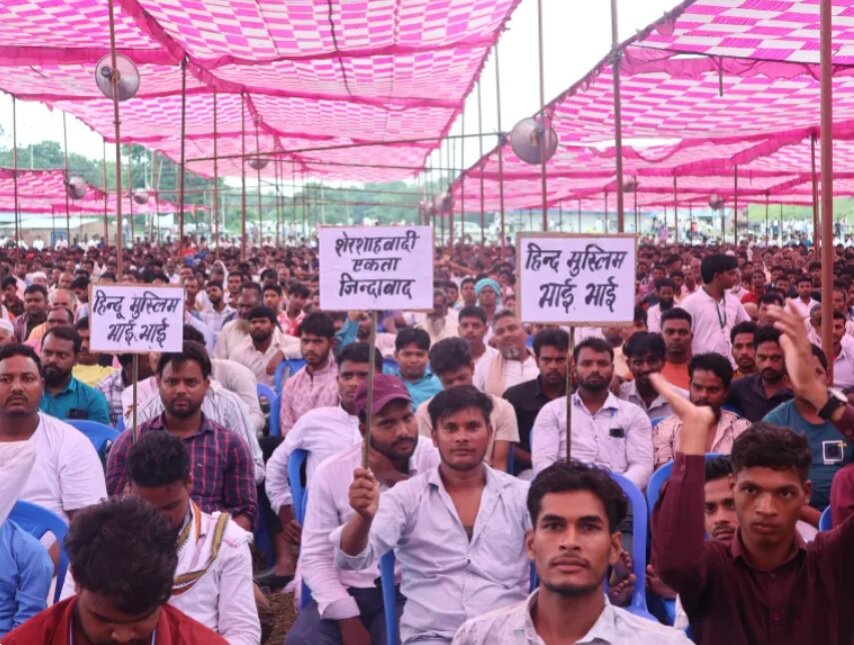
AhlulBayt News Agency (ABNA): As state elections approach in India’s Bihar, political and media attacks against the Muslim Shershahabadi community have sharply escalated. This linguistic and religious minority, concentrated in areas bordering Bangladesh, is being labeled by Prime Minister Narendra Modi’s ruling Bharatiya Janata Party (BJP) as “Bangladeshi infiltrators.”
Mukhtar Alam, a Muslim resident of Kishanganj district, said that social life in the region fractured after a BJP leader publicly described the Shershahabadis as “illegal Bangladeshi migrants.” “My long friendship with a Hindu classmate broke apart after that speech,” he said, noting that distrust has since spread among neighbors.
According to the 2023 caste census, more than 1.3 million Shershahabadi Muslims live in Bihar, most of them in the impoverished Seemanchal region, including Kishanganj and Katihar—areas now at the center of the BJP’s campaign. In his Independence Day address, Modi announced that his government had launched a “special demographic mission” to identify and deport so-called infiltrators, declaring: “No country should surrender itself to infiltrators.”
Critics argue that similar initiatives in other states, such as Assam, have targeted Bengali-speaking Muslims under the pretext of curbing illegal immigration. The controversial National Register of Citizens (NRC) process in Assam in 2019 resulted in nearly two million Muslims being excluded from the official list of citizens. Several BJP leaders are now calling for a comparable program in Bihar.
In recent months, influential BJP figures, including Giriraj Singh, a central government minister, have delivered inflammatory speeches at campaign rallies in Seemanchal. “Demons have come from Bangladesh, and they must be destroyed,” Singh declared at one gathering. Observers say such rhetoric is intended to create religious polarization and consolidate Hindu votes in other parts of Bihar.
Meanwhile, India’s Election Commission has reportedly removed about six percent of voters from electoral rolls during a special review process. In Kishanganj, where Muslims make up around 70 percent of the population, the rate of deletion reached 9.7 percent, a move critics describe as an attempt to disenfranchise Muslim voters.
Social activists and academics warn that these policies are deepening fear, mistrust, and social division between Hindus and Muslims. Many Islamic schools and health centers in Bihar have reported a noticeable decline in Hindu visitors.
Alam, a 30-year-old teacher from the Shershahabadi community, said, “Every time politicians talk about us, we have to prove that we’re not infiltrators. These words have infected our community like a disease.”
**************
End/ 345



