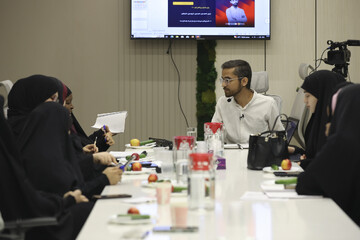
AhlulBayt News Agency (ABNA): Hojat al-Islam Hossein Ghorbani Naeini, delivering the keynote address, opened by referencing the longest epistle in Nahj al-Balagha—the covenant of Malik al-Ashtar. He noted that at the end of this letter, Imam Ali (a.s.) offers two supplications: one for himself and one for Malik al-Ashtar, asking that both attain felicity and martyrdom. He explained that Imam Ali’s understanding of martyrdom reflects it as the summit of servitude and the highest form of human felicity.
Turning to Lady Fatimah’s Sermon of Fadak, Ghorbani Naeini stated, “This radiant sermon, which contains more than twenty Quranic verses, extends far beyond the matter of Fadak. It addresses monotheism, prophethood, Imamate, resurrection, beliefs, and rulings.” He underscored that this sermon provides a roadmap for the Islamic Ummah today and can serve as a basis for unity. He further highlighted Lady Fatimah’s profound knowledge, noting that just as Imam Ali (a.s.) affirms in Nahj al-Balagha that God created the world without pre-existing material, Lady Fatimah conveys the same truth, demonstrating her scholarly depth.
Quoting Imam Reza (a.s.), he explained that the Quran frequently pairs piety with maintaining kinship ties, meaning that one who severs familial bonds cannot be considered truly pious. He warned that neglecting these ties results in diminished blessing, while the great figures of Islam attributed their success to honoring family relations and avoiding discord. Citing the verse “Do not die except as Muslims” (Quran 3:102), he stressed that a person must ensure that the final moment of life is spent in servitude to God, noting that history records individuals with distinguished pasts who faltered at the end.
Ghorbani Naeini then referred to the story of Prophet Abraham (a.s.) and Ishmael (a.s.), observing that even in the most demanding divine test, Abraham addressed his son kindly and sought his view. This, he said, offers a model for parents to foster friendship with their children and honor their dignity. He warned that neglecting this bond leaves children vulnerable to outside influences and cautioned that mobile phones and social media risk becoming “graveyards of youth” that consume time and potential.
He also recounted an anecdote about Ayatollah Sayed Ahmad Zanjani, father of Grand Ayatollah Shobeiri Zanjani, who, after every congregational prayer, spent ten minutes writing Quranic verses and the Jowshan Kabir supplication on his own shroud. This practice, he said, illustrates effective time management and how even brief moments can become a spiritual investment.
In closing, he emphasized, “The first verse recited by Lady Fatimah in the Sermon of Fadak—‘O you who believe, fear Allah as He should be feared’—must be our guiding principle. It should be displayed in homes, workplaces, and markets as a reminder of piety and of refraining from transgressing divine boundaries.”