
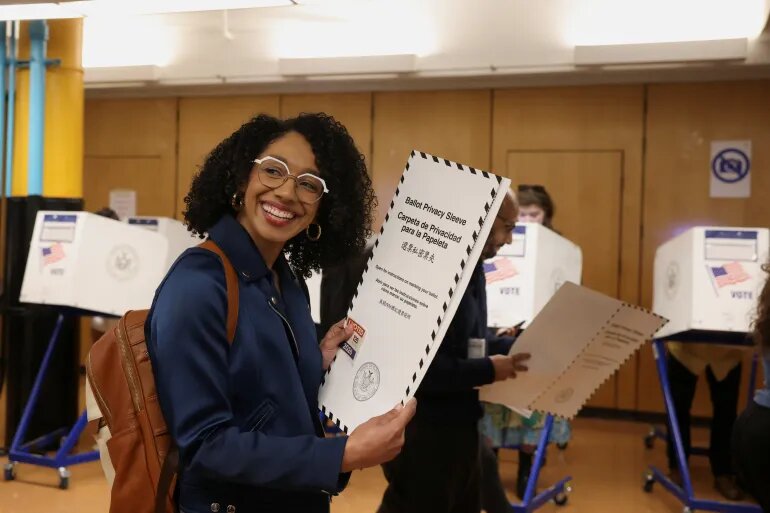
AhlulBayt News Agency (ABNA): Darializa Avila Chevalier, a Muslim activist, succeeded in winning the seat of New York's 13th congressional district in the US House of Representatives in the midterm elections of November 3, 2026. A victory that is the culmination of her remarkable political rise, a path that began with student protests and civil rights movements and led to the unseating of one of the prominent figures of the Democratic Party in New York City.
According to a report by Al Jazeera, Chevalier won the race against Jogomo Williams, the Republican candidate. This comes as Chevalier had also caused an upset a few months earlier by defeating Adriano Espaillat, the veteran Democratic representative and chairman of the Congressional Hispanic Caucus in the House of Representatives, in the Democratic Party primaries.
The significance of Chevalier's political rise is not limited to her religious identity; rather, in her experience, three political currents have intersected. The social justice movement in whose context she began her activity, the democratic socialism she believes in, and the pro-Palestine movement in which she has participated since her studies at Columbia University.
These currents merged in her election campaign. A campaign that enjoyed the support of Zohran Mamdani, the mayor of New York, and was able to defeat one of the most prominent representatives of the traditional Democratic Party structure in this city.
From a poor family with Dominican roots to Columbia University
Chevalier was born in 1993 in the state of Florida to a family with immigrant parents from the Dominican Republic. She spent her childhood between America, the Dominican Republic, and Venezuela. Her family struggled with financial problems, and her mother, who worked in the field of social services, took on most of the responsibility for raising her, while her father was a truck driver.
Chevalier, in an interview with Vanity Fair magazine, recounted a memory from her childhood. When her mother asked her to search inside the car for coins so they could cover the fuel cost needed to go to school. According to her, one of the gas station employees noticed that they could not afford to pay and, in exchange for a dollar this girl had collected, gave them five dollars' worth of fuel.
Chevalier considers this memory one of the moments when she first became aware of class differences.
In 2012, she went to New York to study at Columbia University and received her bachelor's degree in Middle Eastern studies. During this period, she turned to activity in student organizations opposed to sexual violence, racism, and the Zionist regime's policies toward Palestinians.
She later collaborated with the organization "Families for Freedom," an organization that defends immigrants facing deportation. Chevalier participated in legal efforts to free detainees of the US Immigration Department and then worked as a researcher and investigator in the public defender's office in the Harlem neighborhood.
Chevalier began studying for a doctorate in sociology at the City University of New York in 2019. Her research topic is the relationship between the criminal justice system and the deportation of Black immigrants of Latin American origin. She also has a history of university teaching and has joined the United Auto Workers union.
How did she become Muslim?
Chevalier was not raised in a Muslim family; most of her family members are followers of Catholic Christianity. However, she herself emphasizes that she did not have a strict religious upbringing. Nevertheless, the experience of activity in civil rights movements and friendship with Muslim activists placed a different path before her for understanding religion.
She recounted in a detailed interview with the City & State New York news outlet that in Ramadan of 2019 or 2020, out of curiosity, she decided to try fasting. She repeated this experience the following year and continued fasting in Ramadan for several years without officially declaring her conversion to Islam.
Chevalier recalls that in the fourth year of fasting, one of her Muslim friends asked her why, despite continuing to perform this obligation, she had still not decided to accept Islam. According to her, this very question made her be honest with herself and accept that she truly wanted to become Muslim.
A few days later, she participated in a session to study the Quran. At this session, the prayer leader spoke about the two divine attributes of mercy and forgiveness and the possibility of returning to God when feeling doubt. Chevalier says she cried upon hearing these words because she felt she had found the tranquility she was seeking.
The Palestine experience and its impact on her religious path
Chevalier's religious path is also linked to her experience of being present in the Palestinian territories. In the summer of 2014, when she was 20 years old, she spent about two months in the city of Nablus in the West Bank, where she taught English to Palestinian children.
She says that after returning from this trip, her view of power, violence, and justice had changed because she had seen closely the restrictions imposed on the daily lives of Palestinians. Shortly after her return, the Zionist regime's war against Gaza also began.
This experience pushed Chevalier to participate in the "Students for Justice in Palestine" movement at Columbia University. She also participated in efforts to pressure the university to divest its investments from companies affiliated with the Zionist regime.
Thus, Chevalier presents the story of her conversion to Islam as a spiritual and personal experience intertwined with her social activities and not merely a change of religion and belief separate from her intellectual and political path.
What is socialism in Chevalier's view?
Chevalier considers herself a democratic socialist and is a member of the New York chapter of the Democratic Socialists of America. An organization that supported the election of Zohran Mamdani as mayor of New York and in which prominent political figures such as Alexandria Ocasio-Cortez and Rashida Tlaib, members of the US Congress, are also members.
Chevalier, against the Republicans' approach that uses the word "socialism" as synonymous with communism or complete government control over the economy, offers a different definition. Her view focuses on wealth redistribution, expanding public services, and strengthening the role of workers in determining economic policies.
In her last interview with Vanity Fair magazine, she explained that the Democratic Socialists organization is not an independent political party but an organization based on membership and social activity. Chevalier emphasized that she herself is a member of the Democratic Party and runs in elections under this party's name; although there are also differences of intellectual view within the socialist organization.
She also said that she does not agree with all of this organization's positions at the national level, including some proposals to abolish the US presidency.
Economic and social priorities
Chevalier has placed universal healthcare, increased investment in public housing, combating child poverty, and limiting the influence of large corporations and funders of political campaigns at the top of her agenda.
In an interview with the Spanish newspaper El País, she considered Social Security and the government health insurance program "Medicare" as two examples of social policies that have proven their popularity in America.
Chevalier has more radical positions on some other issues. She has called for the abolition of the US Immigration and Customs Enforcement (ICE) and in the long term defends replacing the prison system with a model that prioritizes crime prevention and addressing its social roots. She acknowledges that achieving such goals requires long-term political and social developments.
From protesting for Gaza to winning the congressional elections
Chevalier's name became more prominent than before during the pro-Palestine protests held in the spring of 2024 at Columbia University. As a graduate of this university, she participated in organizing the students' sit-in and was among the activists arrested during the clashes related to the protests.
Her name is also tied to Mahmoud Khalil, a Palestinian activist and one of the prominent figures of the student movement. Someone who was arrested by US immigration authorities in March 2025. Chevalier participated in campaigns demanding Khalil's release and criticized the Trump administration's treatment of students and pro-Palestine activists.
These activities became one of the main axes of Chevalier's election campaign. During the election campaigns, she criticized the continuation of US military aid to the Zionist regime and called for allocating federal resources to schools, housing, and healthcare services. Her election slogan also emphasized the link between spending on children and spending on wars.
Chevalier, in an interview with Vanity Fair, defended her participation in the pro-Palestine demonstrations on October 8, 2023. She said that her protest was directed at America's policy of supporting and arming the Zionist regime and that at that time she was worried that a large number of Palestinian civilians would become victims.
How did she unseat one of New York's most powerful representatives?
Chevalier faced Adriano Espaillat, 71, in the Democratic Party primaries. A representative who had held New York City's 13th congressional district for about 10 years and had taken on the chairmanship of the Congressional Hispanic Caucus in the House of Representatives.
Espaillat enjoyed a broad network of political and union relations and also had the support of the Democratic Party's traditional funders behind him. However, his young rival focused her campaign on the issue of declining purchasing power and the difficulty of covering living costs and criticized Espaillat's relations with the real estate sector and lobby groups supporting the Zionist regime.
According to an investigation published by the City & State news outlet, Espaillat enjoyed the support of funders affiliated with the American Israel Public Affairs Committee (AIPAC) and benefited from the multi-million-dollar spending of independent political committees.
In contrast, Chevalier also benefited from independent spending in her favor, especially from the "Democrats for Justice" organization, which had previously played a role in Ocasio-Cortez's political rise.
One of the milestones of Chevalier's campaign was Mamdani's announcement of support for her. This came as the mayor of New York had previously had close political relations with Espaillat.
Chevalier also benefited from a network of volunteers formed during Mamdani's election campaign. She said that her election campaign and the coalition of organizations supporting her knocked on the doors of more than 155,000 homes to communicate directly with voters.
From political controversies to racist attacks
Chevalier's election campaign was not without controversy. Her opponents republished her old social media posts in which she had used insulting expressions against some Democratic Party figures, including Kamala Harris and Joe Biden. They also highlighted her previous statements about the need to abolish prisons, police, and borders.
Chevalier apologized for one of her insulting posts about Harris and said that her political language has changed over the years, but she did not retreat from her positions in defending the rights of immigrants and Palestinians or her support for democratic socialism.
In contrast, she also faced attacks on her racial and religious identity. A former adviser to Espaillat accused Chevalier and Mamdani of seeking to change the demographic composition of the Washington Heights neighborhood and replace Dominican residents with Haitian immigrants and Muslims.
Espaillat condemned these remarks, and Chevalier also considered them part of a racist and Islamophobic campaign.
Thus, Chevalier does not merely add a new representative to the ranks of Muslims in the US Congress. Rather, she is an example of a political path in which Islam as a religious identity, democratic socialism as an economic approach, and solidarity with Palestine as one of the main axes of public activity have been placed alongside each other.
**************
End/ 345E



