
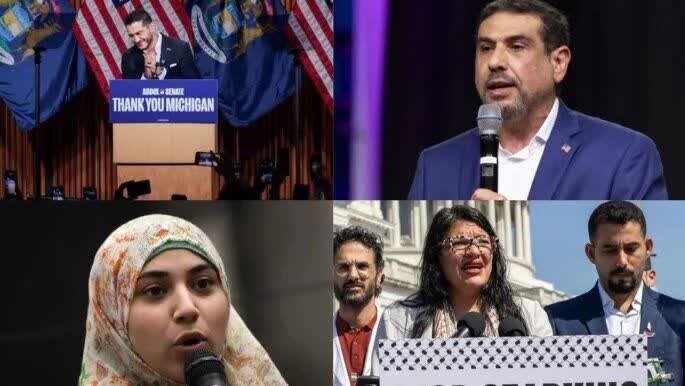
AhlulBayt News Agency (ABNA): Muslim candidates in the US midterm elections on November 3, 2026, succeeded in winning seats in Congress and state legislatures in races that were accompanied by an increase in Islamophobic remarks and attacks against Muslim communities.
According to this report, at least seven Muslim candidates, including one senator and six representatives of the House of Representatives, entered Congress. Alongside them, a number of Muslim and Palestinian-origin candidates also won in state legislature races.
Abdul El-Sayed; the first Muslim to enter the US Senate
Abdulrahman Mohamed El-Sayed, the Democratic candidate and 42-year-old Egyptian-origin physician, by defeating Mike Rogers, the Republican candidate, in Michigan's Senate election, became the first Muslim elected to the US Senate.
He, a specialist in medicine and public health, focused in his election campaign on expanding healthcare services, reducing living costs, and limiting the influence of large corporations in politics. El-Sayed was also a critic of US military aid to the Zionist regime.
Six Muslim representatives in the US House of Representatives
Adam Hamawy, an Egyptian-origin surgeon and retired US Army military officer, won by defeating Greg Mele, the Republican candidate, in New Jersey's 12th congressional district and became the first Muslim of this state to enter Congress.
Hamawy, who has a history of serving as a combat physician in the US Army and being present in the Iraq war, went to Gaza in 2024 to treat Palestinian wounded. During this medical mission, along with a group of physicians, he was trapped after the closure of the Rafah crossing in southern Gaza. Hamawy in his election campaign had called for stopping US military aid to Israel, expanding universal healthcare coverage, and canceling medical and student debts.
Rashida Tlaib, the Palestinian-origin representative of the Democratic Party, also entered the House of Representatives for a fifth term by winning the Michigan elections. She, who has been present in Congress since 2018, was one of the two Muslim women of the first term of Muslim women's entry into the US House of Representatives and is still considered a staunch critic of Israel's war against Gaza and Washington's military support for this regime.
Ilhan Omar, the Somali-origin representative of the Democratic Party, also gained her fifth term of presence in the House of Representatives by winning Minnesota's fifth congressional district. Ilhan Omar has been the representative of this district since 2019 and has repeatedly criticized America's policies toward Palestine and this country's support for Israel. She has also been the target of verbal attacks by US President Donald Trump in past years.
Darializa Avila Chevalier, the 33-year-old Democratic candidate of Dominican origin, won in New York's 13th congressional district. She is the first Muslim woman of Latin American origin to enter the US House of Representatives. Chevalier was previously known through civil rights activities and participation in pro-Palestine protests.
André Carson, the Muslim Democratic representative from the state of Indiana, also preserved his seat by winning the elections of this state's seventh district. He has been the representative of this district in the US House of Representatives since 2008.
Latifa Simon, a civil rights activist and Democratic candidate in California, also won in this state's 12th district elections and gained another term of her representation in the House of Representatives.
The presence of Palestinian-origin figures and Muslims in state senates
The victory of Muslim and Arab-origin candidates was not limited to Congress, and a number of them also succeeded in winning seats in state legislature elections.
Abe Kwoka, a Palestinian-origin activist, won in the elections of New York's 12th state Senate district. His family was driven from their land during the displacement of Palestinians in 1948 and finally immigrated to America. Kwoka in his election campaign emphasized issues such as affordable housing, healthcare services, immigrants' rights, and opposition to America's financial support for Israel's war against Gaza.
Abbas Alawieh, the Lebanese-origin Democratic candidate, also won in Michigan's second state Senate district, including the Dearborn area and its surrounding areas. He was one of the founders of the "Uncommitted" movement; a movement that protested Joe Biden's support for Israel in the 2024 US presidential elections.
Nabeela Syed, the Indian-origin Muslim candidate of the Democratic Party, by defeating Darby Hills, the Republican candidate, won in Illinois's 26th state Senate district. She, who was previously a state assembly representative, with this victory was able to take the contested seat out of Republican control.
The continuation of the presence of Muslim women and Palestinian-origin representatives in state legislatures
According to media reports, a number of other Muslim women also won in state legislature elections. Iman Jodeh in Colorado's 29th state Senate district and Rawa Raman in Georgia's seventh state Senate district were among the victorious Palestinian-origin candidates.
Also, Zainab Mohamed in the state of Minnesota, Munira Abdullahi in Ohio, Maryam Khan in Connecticut, and Madinah Wilson-Anton in Delaware were among other Muslim women who won in state legislature elections.
In the state of Illinois as well, Abdelnasser Rashid, the Palestinian-origin Democratic candidate, according to election result projections, was able to preserve his seat in the state House of Representatives.
Among other Muslim representatives who succeeded in preserving their seats in the elections, one can mention Salman Bhojani and Suleman Lalani in the Texas House of Representatives, Saud Anwar in the Connecticut state Senate, and Tarik Khan in the Pennsylvania House of Representatives.
These victories came in circumstances where Muslim candidates, especially El-Sayed in Michigan, had faced attacks and accusations about their religious background and alleged connection with extremist groups; the media have described these races as part of the more prominent presence of Arab-origin and Muslim candidates in America's political structure.
**************
End/ 345E



