

AhlulBayt News Agency: Hujjatul Islam wal Muslimeen Dr. Hakim Majid Elahi, the representative of the Wali-e-Faqih in India, recently visited Imarat-e-Sharia in Patna, where he was warmly received by the institution’s Nazim, Maulana Mufti Mohammad Saeedur Rahman.
The visit featured discussions on religious education, community welfare, Muslim unity and the role of Islamic institutions in strengthening solidarity among Muslims.
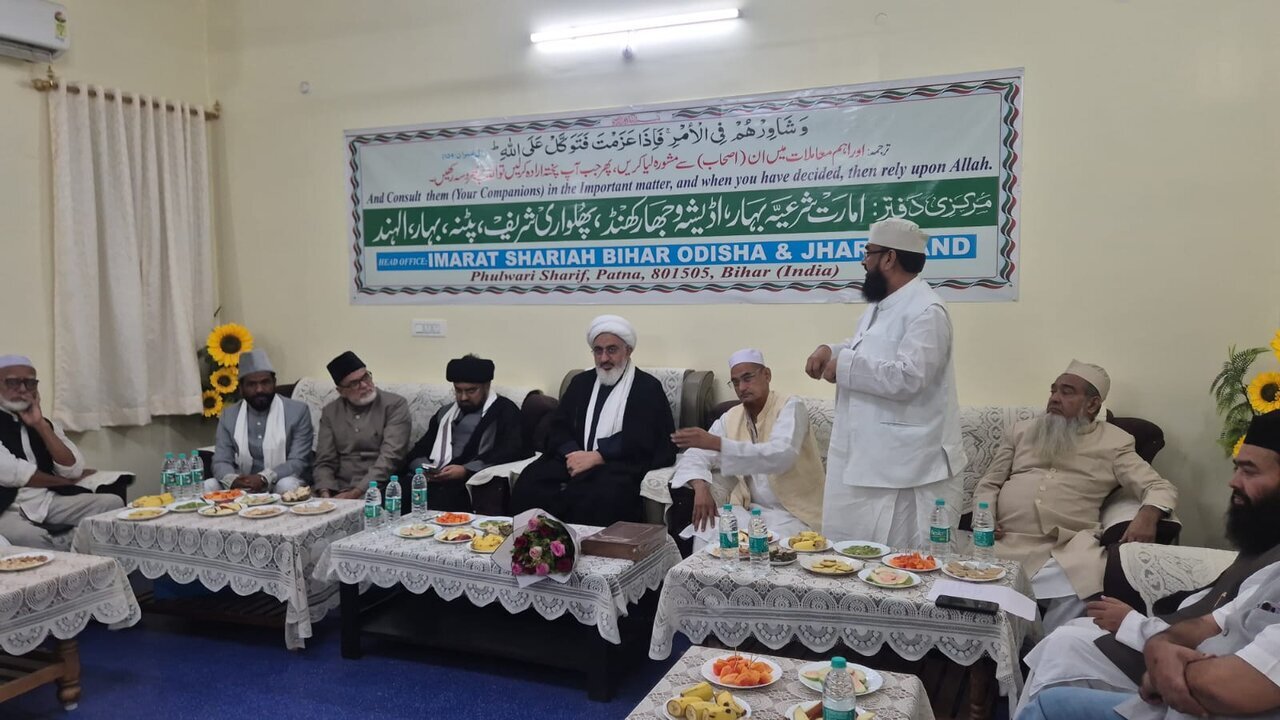
Maulana Mufti Mohammad Saeedur Rahman welcomed the distinguished guest with warmth and respect and presented him with a bouquet.
Following the reception, Mufti Mohammad Sohrab Nadwi Qasmi, Naib Nazim of Imarat-e-Sharia, provided a detailed briefing on the institution’s activities, responsibilities and services to the Muslim community.
Addressing the gathering, Dr. Hakim Majid Elahi said that becoming a doctor or an engineer was relatively easy, whereas becoming a Mufti or an Islamic scholar required considerably greater dedication and effort.
He praised Imarat-e-Sharia for its important work in promoting the fundamental teachings of Islam and said that fostering unity within the Muslim community was a responsibility incumbent upon every Muslim.
“The services rendered by Imarat-e-Sharia deserve the highest appreciation. I am extremely pleased to visit this institution today,” he said.
Dr. Elahi noted that the institution had fulfilled the responsibilities expected of a religious organisation by providing a wide range of services to the community.
He highlighted its efforts to assist the poor, care for the needy, promote education, provide medical treatment to the sick and support vulnerable people, describing these activities as central to the message of Islam.
He expressed gratitude to Allah for enabling the historic institution to continue its humanitarian and religious services.
Dr. Elahi also called for greater unity and mutual harmony among Muslims, emphasising that promoting solidarity was among the fundamental objectives of Imarat-e-Sharia.
He said that preserving and strengthening the atmosphere of unity was a moral responsibility shared by all members of the community.
Maulana Taqi Haider, speaking on the occasion, said that unity could become the community’s greatest strength and stressed the need for Islamic scholars to stand together to achieve that objective.
Imarat-e-Sharia praised for humanitarian services
The meeting was attended by several prominent religious and community figures, including Mufti Mohammad Sana-ul-Huda Qasmi, Naib Nazim of Imarat-e-Sharia; Maulana Ahmad Hussain Qasmi and Maulana Mohammad Abul Kalam Shamsi, both Assistant Nazims; Dr. Syed Yasir Habib, secretary of Maulana Sajjad Memorial Hospital; Maulana Arshad Rahmani, Hafiz Secretary; Maulana Mohammad Shariq Rahmani, Assistant Office Secretary; Maulana Mohammad Niyaz Alam Qasmi; Advocate Javed Iqbal, trustee of Imarat-e-Sharia; and Maulana Syed Amanat Hussain, general secretary of Bihar Majlis-e-Ulema wa Khutaba.
Other prominent personalities were also present.
Participants highlighted their longstanding association with Imarat-e-Sharia and praised its extensive services, saying that the institution’s humanitarian approach was one of its defining characteristics.
They noted that assistance was provided on the basis of humanity rather than an individual’s religious denomination or sectarian affiliation.
Maulana Syed Tahzeebul Hasan Rizvi, president of the Jharkhand Shia Personal Board, also praised the institution’s work and recalled his longstanding relationship with it.
He said Imarat-e-Sharia had the potential to unite Muslims from Bihar, Jharkhand and Odisha and transform them into a strong and influential community.
Ayatollah Khamenei’s martyrdom and Muslim solidarity
Participants also emphasised that the martyrdom of Ayatollah al-Uzma Syed Ali Khamenei had played an important role in bringing Muslims together.
They said the loss had not been mourned solely by the Shia community, but had also drawn expressions of grief from Muslims and other monotheists.
The scholars stressed that the atmosphere of unity and brotherhood emerging from the sacrifice of the martyred leader should not be forgotten. Instead, they called for efforts to strengthen and expand it further.
They said that preserving this solidarity would be a meaningful way to pay tribute to the late leader.
Mufti Mohammad Sana-ul-Huda Qasmi remarked that Muslims across the world had prayed for Iran’s success and that their prayers had played an important role in its victory.
Responding to the remarks, Dr. Hakim Majid Elahi said that Muslims had not only offered prayers but had also provided practical support to Iran.
He expressed regret that some Muslim-majority countries had supported Christianity and Zionism instead of standing with Islam, describing the situation as deeply unfortunate.
Dr. Elahi further said that if Muslims understood these realities, the Muslim Ummah could attain a position of strength and dignity rather than continue to live under conditions of subjugation.
He argued that the continued experience of subjugation reflected the community’s surrender to falsehood.
Although Amir-e-Shariat Maulana Faisal Rahmani was unable to attend the meeting in person, he remained in regular contact and continued to receive updates about its proceedings.
At the conclusion of the gathering, the Nazim of Imarat-e-Sharia expressed his desire for Dr. Elahi to visit the institution frequently, saying that his continued presence would help create a renewed and positive atmosphere.




Your Comment