AhlulBayt News Agency (ABNA): Ayatollah Sayyid Yassin al-Mousawi, the Friday Prayer Leader of Baghdad and a prominent professor at the Najaf Seminary, in remarks elaborated on the various dimensions of the great Arbaeen march.
The Friday Prayer Leader of Baghdad emphasized that the Arbaeen march is not merely a religious occasion or an act of worship, but a great and divine ritual with religious, political, social, and civilizational dimensions that demonstrates the true continuation of the movement of Imam Hussain (a.s.) and the message of Islam in confronting oppression and tyranny.
Stating that the recommendation of walking toward the holy shrine of Imam Hussain (a.s.) has been emphasized in the narrations of the AhlulBayt (a.s.), he said, "The visitation of Arbaeen on the twentieth of Safar has been explicitly mentioned in the hadiths of Imam Sadiq and Imam Hadi (peace be upon them), and in the narrations, it has been counted among the signs of a believer; as stated in the famous hadith: 'The signs of a believer are five: performing fifty-one units of prayer, prostrating on soil, visiting Arbaeen, wearing a ring on the right hand, and saying Bismillah al-Rahman al-Rahim aloud.'"
The Friday Prayer Leader of Baghdad added, "This visitation has deep historical roots, dating back to the return of the AhlulBayt (a.s.) caravan to Karbala and the visitation of Jabir ibn Abdullah al-Ansari to the holy shrine of Imam Hussain (a.s.), but its true philosophy goes beyond a historical event and embodies the school of sacrifice, martyrdom, and the struggle against oppression."
He stated, "The holy shrine of the Master of the Martyrs (a.s.) throughout history has been the center of uprisings against tyrannical governments, and many of the uprisings of the Alawites and Shiites of the AhlulBayt (a.s.) began with the renewal of allegiance beside his noble shrine. The Ashura uprising paved the way for the movement of Zayd ibn Ali; a movement that ultimately played a role in the collapse of the Umayyad rule."
Referring to the political dimensions of this ritual, Ayatollah al-Mousawi stated, "This truth became evident in Iraq, particularly during the intifada of 1977; when the Ba'ath regime under Ahmad Hassan al-Bakr and his deputy Saddam Hussein banned the Arbaeen visitation, but the people of Najaf and thousands of pilgrims rose up with a widespread uprising against this decision; an uprising that the Ba'ath regime responded to with repression, killing, and mass arrests of pilgrims."
He continued, "After the fall of the Ba'ath regime in 2003, the million-strong Arbaeen march also revealed its national role. This march coincided with discussions about drafting the Iraqi Constitution; while the U.S. occupation government insisted on the drafting of the constitution by a committee appointed by itself, the supreme religious authority under the leadership of Grand Ayatollah Sayyid Ali al-Sistani (may his shadow be prolonged) emphasized that the constitution should be drafted by the Iraqi nation and then put to a public referendum."
The Friday Prayer Leader of Baghdad added, "Paul Bremer, the then-U.S. civilian administrator in Iraq, acknowledged in his memoirs that observing the million-strong movement of people toward Karbala led him to conclude that ignoring the will of the religious authority and the Iraqi nation could lead to widespread social explosion, and this very issue compelled the United States to retreat and accept the constitutional referendum."
He noted, "Perhaps many Iraqis are unaware of the global impact of the Arbaeen march, but the world recognizes this movement as a practical declaration of loyalty to Imam Hussain (a.s.), a symbol of opposition to occupation, dictatorship, and oppression, and a sign of the unity and cohesion of the Islamic Ummah."
The Million-Strong Funeral of the Martyred Leader; A Sign of the Depth of Public Awareness
Ayatollah al-Mousawi, referring to the million-strong funeral of the martyred Imam Sayyid Ali Hosseini Khamenei (may his pure soul be sanctified), described it as a sign of the depth of public awareness and the adherence of nations to the ideals of the Islamic Ummah, and said, "Nations today are more prepared to defend their religion and sanctities; just as they proved this readiness in defending Iraq against the terrorist ISIS group, both before and after the issuance of the fatwa of defensive jihad."
He stated, "Today's Iraqi society is fundamentally different from the society of the era of Imam Hassan and Imam Hussain (peace be upon them), and it possesses a spirit of resistance and readiness for sacrifice. The famous slogan of the pilgrims during the 1977 intifada, where they said, 'If they cut off our hands and feet, we will crawl to you, O Hussain,' is evidence of this truth. Therefore, superficial analyses of the Arbaeen march cannot explain the doctrinal, social, and political dimensions of this great movement."
The Friday Prayer Leader of Baghdad, referring to the increasing presence of foreign pilgrims in the Arbaeen ceremonies, said, "After Iraq, the Islamic Republic of Iran has the largest share in the presence of Arbaeen pilgrims, and every year millions of Iranian pilgrims participate in this ceremony; an issue that, according to him, has caused concern for the United States and has compelled it to try to prevent this widespread presence."
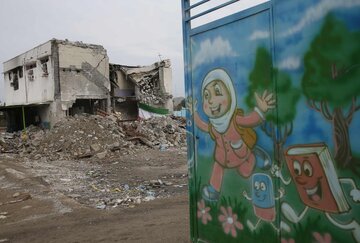
Referring to the attack on Arbaeen pilgrims in the Shalamcheh area, he stated, "Shalamcheh is a border crossing specifically for the passage of pilgrims and has no military center; therefore, targeting the pilgrims was a deliberate action against the Hussaini rituals."
The Project of Imam Hussain (a.s.); A Divine Plan, Not a Political One
Ayatollah al-Mousawi emphasized, "America considers Shiite rituals as a source of public awakening, justice-seeking, and confrontation with oppression, but the project of Imam Hussain (a.s.) is not a political project dependent on a specific current, but a divine plan that follows the guidance of Imam Hussain (a.s.) and Imam Mahdi (a.s.), and for this reason, all efforts to stop or limit it have failed."
In another part of his remarks, criticizing the statements of some Iraqi officials about U.S. cooperation with Iraq in confronting ISIS, he said, "These statements stem from a misunderstanding of political realities. U.S. forces were supporting ISIS, while what came to Iraq's aid on the ground were the commanders and advisors of the Islamic Republic of Iran; including the martyred Hamid Taqavi and a group of IRGC commanders who were martyred in defense of Iraq and its people."
The Friday Prayer Leader of Baghdad concluded by emphasizing, "Just as Saddam Hussein's regime failed to eliminate the Hussaini rituals, all of America's efforts to contain or politically exploit the Arbaeen march will also fail. The nations of Iraq, Iran, Lebanon, Yemen, the Persian Gulf countries, and the Levant are a single Ummah against a common enemy, and the future of this Ummah is the future of victory and triumph."
**************
End/ 345E