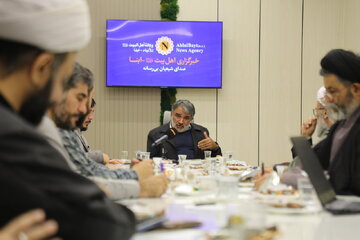
AhlulBayt News Agency (ABNA): A conference of officials from political and religious organizations and members of the Pakistani Ulema Assembly was held Saturday at the AhlulBayt World Assembly conference hall with a speech by Ayatollah Ramazani, the Secretary-General of the AhlulBayt World Assembly. At the beginning of his remarks, Ayatollah Ramazani described this meeting, formed with the aim of focusing on the identity of Pakistani Shia, as a "turning point" that could be very influential in the future leadership of Shia in that country. Congratulating Eid al-Adha, he stated that the great lesson of the architect of monotheism, Prophet Abraham (a.s.), is that all aspects of human life, including prayer and worship, should be for the purpose of proximity to God.
Ayatollah Ramazani also, referring to the upcoming Eid al-Ghadir, described the greatest lesson of this Eid as the influence of people's will on their destiny and the necessity of the rule of "the best." Because God introduced the Commander of the Faithful (a.s.)—who, by the admission of all Muslims, is the most knowledgeable, bravest, most ascetic, and most devout of people, and the companion of truth and the Qur'an—as the ruler. Explaining the concept of Imamate, the Secretary-General of the AhlulBayt World Assembly considered its main result to be the "struggle against ignorance" (Jahiliyyah) and noted that the Noble Prophet (p.b.u.h.) stood against the pre-Islamic ignorance through education and upbringing and built a prophetic society.
Referring to the return of ignorance at the time of Imam Hussain (a.s.), he described the Imam's sacrifice as an action to counter this deviation and added that in the contemporary era, the Imamate of Imam Khomeini (r.a.) and the "Martyred Imam" has been a path to confront "modern ignorance." He considered these gatherings and the unity achieved among scholars as a response to this historical necessity.
The Necessity of Shia Unity and the Strategic Legacy of the Leadership
Ayatollah Ramazani, reviewing the historical demands of the martyred Leader, referred to his message in 1989 (1368 AH) to the members of the Shia Consensus Assembly, in which he called the "primary and absolute duty" in Pakistan "unifying the Shia." He also emphasized the importance of his detailed speech in 1991 (1370 AH) and asked those present to study it as a strategic document, as it pointed to the deep influence of the old colonialism of England, the Americans, and the agents of arrogance in the subcontinent. The Secretary-General of the AhlulBayt World Assembly stated that despite complex problems and heavy costs for spreading true Islam, Pakistan is witnessing vibrant movements among both Sunnis and Shia.
Ayatollah Ramazani then pointed to the colonial policy of "divide and rule" in the subcontinent, which was the root of many massacres among Muslims, Hindus, and Sikhs, and stated that the enemy has even created divisions among the internal sects of Sunnis and Shia, the effects of which still remain. Honoring the memory of martyrs such as Allama Arif Hussain al-Hussaini and appreciating the efforts of great figures such as Allama Sheikh Mohsen Ali, Allama Sheikh Syed Riaz, Allama Sajid, Allama Syed Javad, and Allama Raja Nasir, he considered the current convergence among organizations in Pakistan's five provinces to be very valuable.
Dual Strategies: Internal Strengthening and External Interaction
Based on the intellectual system of the martyred Leader, the Secretary-General of the AhlulBayt World Assembly considered two basic tasks as part of the Assembly's programs: first, "strengthening the Shia identity" against discord and hypocrisy; and second, "the identity-based interaction of Shia with non-Shia." He emphasized that seminary students and clerics must become familiar with these strategies. Explaining the concept of unity in the words of Imam Khomeini (r.a.), he considered it a source of political, economic, and scientific power for Muslims and reminded that the West took science from Muslims but did not make its specialized parts available to others.
He pointed to the Leader's prediction about the necessity of institutionalizing the unity of the Islamic Ummah by scholars and academics in the coming decades and said that if Sayyid Jamal al-Din Asadabadi's idea of "United Islamic Republics" had been realized, neighboring countries would never have become military bases for the hegemonic system of disbelief. Ayatollah Ramazani noted that today, blessed by the discourse of the AhlulBayt (a.s.) and the Islamic Republic system, the claim of American power and the new world order has been shattered.
Organizational Modeling and the Necessity of Elite Synergy
Ayatollah Ramazani proposed that to strengthen unity, an "Organization of Islamic Scholars" should be formed in Pakistan, similar to the successful experience of Lebanon, with the participation of great Shia and Sunni scholars, so that differences in methodology and propaganda do not allow enemies to exploit them. Referring to his letter to the martyred Leader about Shia currents in Pakistan and his meetings with scholars of that country, he described Pakistan as his own homeland and emphasized the necessity of centering love for the AhlulBayt (a.s.) for Shia-Sunni convergence. He warned that in recent decades, Muslims have been the main victims of enemy plots, including ISIS, Shia-phobia, and Iran-phobia.
He called this meeting a "strategic" session and called on various groups, including the Council of Scholars, Millat-e Jafariya, Ummat Mustafa, Majlis Wahdat-e-Muslimeen, Jamia al-Muntazar, Tanzim al-Makatib, and the Clergy Society of the provinces, to strive for a central assembly to lead the Shia of Pakistan. Referring to the drafting of the by-laws for this assembly, he emphasized that the enemy should not be allowed to exploit the situation any longer.
The Fourfold Process of Transformation in Propagation and Culture
Ayatollah Ramazani defined the operational strategy of this assembly in four steps: 1. "Acquaintance" (understanding each other's capacities), 2. "Understanding" (reaching a shared comprehension), 3. "Interaction" (joint religious and propaganda operations), and 4. "Synergy" for cultural transformation. Citing the verse "And hold firmly to the rope of God," he described unity as a divine blessing that saves believers from the edge of the pit of fire and destruction, emphasizing that failing to manage differences will lead to destruction.
He warned that no organization should consider itself "equal to religion" or the whole truth of the AhlulBayt (a.s.), as the belief that "I am complete and others are incomplete" is the greatest danger. He stated that the common goal is to introduce the "virtues of the AhlulBayt (a.s.)" and invite to monotheism and servitude, not to invite to oneself. Ayatollah Ramazani, emphasizing resistance against the hegemonic system, called on scholars to transform adversarial competitive views into "complementary competition," so that different organizations in political, propaganda, educational, and research fields become complementary to one another.
The Ethics of Disagreement and the New Mission in Muharram and Arba'een
The Secretary-General of the AhlulBayt World Assembly emphasized the necessity of learning the "ethics of difference in taste and method" and, citing examples of different jurisprudential schools such as Baghdad, Najaf, Qom, and Isfahan, considered differences of opinion in propaganda methods for different audiences permissible. He even suggested holding exchange programs for seminary students between different seminaries to eliminate divisive mindsets, so that all serve a single goal: showing the beauty of the words of the AhlulBayt (a.s.).
In conclusion, referring to the 47-year miracle of the Islamic Revolution and the pure blood of the martyrs, he emphasized that Muharram and Arba'een this year must be different from previous years. He outlined three stages for this purpose: "accurate and deep historical narration," "analysis of how and why the Ashura events occurred," and "application to contemporary issues."
At the end, Ayatollah Ramazani, warning against "modern slavery" and the plundering of Muslim wealth by arrogance, described the duty of scholars as identifying the Yazids and Pharaohs of the age and standing against global thieves. He expressed hope and confidence that with the organizational approach and sincerity of Pakistani scholars, we will witness the growth of the teachings of the AhlulBayt (a.s.) in today's thirsty world.
**************
End/ 345