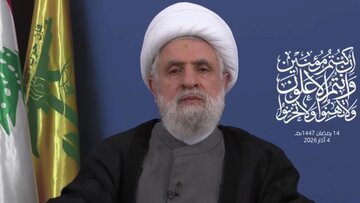
AhlulBayt News Agency (ABNA): Sheikh Adel Shula, a prominent Bahraini scholar, in his speech in the holy city of Qom, emphasizing the necessity of confronting oppression and avoiding complicity with oppressors, criticized Bahrain's developments and the government's policies toward the Shia community, and called for the vigilance of believers against what he called plans to dominate the destinies and religious identity of the Shia community.
Sheikh Adel Shula, referring to religious teachings about the prohibition of consenting to oppression, said, "One who consents to another's oppression is a partner in his oppression, and a believer should not consent even to oppression directed at an enemy." He emphasized that a believing person must be subject to religion and divine values and should not be influenced by instincts, carnal desires, or misleading propaganda.
Government Domination Over Shia Religious Affairs; A Violation of Previous Commitments
He went on to refer to Bahrain's conditions, considering what he called "the policy of dominating the affairs of the Shia community and dealing with its scholars" as an example of despotism and monopolism in governance, and said, "What is happening in this regard is clear oppression, observable in the manner of accusing scholars, arrests, treatment of families and property, interrogation methods, and trial processes."
Shula stated, "This collection of actions is carried out with the aim of creating conditions in which the government can dominate the affairs of the Shia community without any dissenting or protesting voice."
Referring to the arrest of a number of Shia scholars, he placed the responsibility for protesting this situation on those whose religious duty requires them not to remain silent in the face of oppression.
The Bahraini scholar also criticized what he called "government interference in religious affairs" and said, "Religious affairs and religious characteristics must maintain their independence, and religiously and legally, the government should not dominate them."
Criticism of Restrictions on Endowments, Mosques, and Religious Activities
In another part of his remarks, criticizing the government's policies toward Ja'fari endowments, mosques, and Shia husseiniyas, he stated that these interventions have also extended to areas such as religious lecturing and preaching, the Husseini pulpit, religious rituals, and charitable activities.
Shula considered this process a factor in increasing dissatisfaction and social tension in Bahrain and emphasized that this situation is not only caused by arrests, but the continuation of restrictions on the rights and religious characteristics of the Shia community also plays a role in its formation.
Comparing Sheikh Ali Salman's Case with the Trial of Shia Scholars
Shula went on to compare the current situation with the case of Sheikh Ali Salman, the Secretary-General of Bahrain's Al-Wefaq Society, and claimed that the Bahraini government previously used its dispute with Qatar to file charges against Sheikh Ali Salman, while, according to him, Qatar at one point played the role of mediator between the government and the opposition.
He added, "What happened in that period was not merely the trial of an individual, but was related to the political rights of the Bahraini people."
According to Shula, the Bahraini government in the current circumstances is also using its disputes with the Islamic Republic of Iran to try a number of Shia scholars and file charges regarding their views.
Protest Against the Treatment of Shia Scholars and Activists
The Bahraini scholar claimed that in the current circumstances, judicial cases against Shia scholars have gone beyond the level of charges against individuals and have become related to the religious rights of the Shia community.
He also said the scope of government interventions, in addition to political, economic, social, security, and educational rights, has extended to the domain of religious rights and affairs.
Shula concluded by describing the Bahraini government's actions to impose domination over the affairs of the Shia community as "void" and claimed that these actions contradict the characteristics of Shia jurisprudence, some constitutional principles, and the previous commitments of Bahrain's rulers to Shia authorities regarding preserving the independence of their rituals and religious beliefs.
He concluded by emphasizing the necessity of maintaining religious sensitivity and inner opposition to oppression and said a believer must be concerned about his religion, have a living conscience, and distance himself from oppressors.
Sheikh Shula also emphasized the continuation of the duty of enjoining good and forbidding evil, while considering it necessary to observe religious conditions and valid regulations in this regard.
**************
End/ 345E