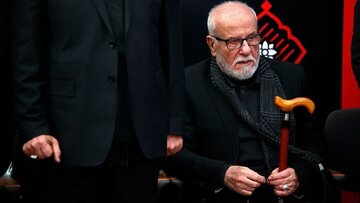
AhlulBayt News Agency (ABNA): Ayatollah Sayyed Yasin al-Mousawi, the Friday Prayer Leader of Baghdad and a prominent professor at the Najaf Seminary, emphasized in his Friday prayer sermons that Iraq is in a sensitive phase of political and regional developments, making the preservation of national sovereignty and the countering of any foreign interference essential.
Warning against efforts to impose the will of foreign powers on Iraqi decision-making, he said, "Some currents are seeking to redesign regional equations to serve the interests of the United States and the Zionist regime."
Referring to Iraq's political process following the recent elections, Ayatollah al-Mousawi stated, "The political process still faces deep problems in the method of selecting the three presidencies and forming the government, and the methods used in past years have brought numerous political and managerial crises to the country."
The Baghdad Friday Prayer Leader also emphasized the necessity of formulating a balanced foreign policy, saying, "The new government must establish positive and balanced relations with all neighboring countries and avoid entering into regional conflicts and tensions."
He added, "Expanding relations with Arab and regional countries should not come at the cost of weakening Iraq's sovereignty and the independence of its political decision-making."
Criticizing what he called "political submission" to certain foreign projects, Ayatollah al-Mousawi stated, "Iraq holds an important historical and civilizational position and can play a pivotal role in the region."
In another part of his remarks, he called for balance in Iraq's relations with global powers, including the United States, Russia, China, and the United Kingdom, emphasizing that Baghdad should not be influenced by external pressures, and that Iraq's political decision-making must be completely independent and based on national sovereignty.
The Baghdad Friday Prayer Leader also criticized direct U.S. interference in the process of forming Iraqi governments, saying, "Some political currents have been subjected to external pressures in the process of selecting officials and forming the government—an issue that threatens the independence of Iraq's national decision-making."
In the economic section of his sermons, Ayatollah al-Mousawi called on the new government to present practical programs to solve livelihood problems, reduce the class gap, and combat unemployment and poverty, emphasizing the necessity of strengthening the middle class to maintain social stability.
He also stressed the need to rebuild and strengthen Iraq's military capabilities, stating, "Iraq needs a strong and well-equipped army to defend the country's sovereignty and security without relying on foreign forces."
Referring to regional developments, the Baghdad Friday Prayer Leader described U.S. policies as aimed at redesigning the region's political structure and weakening the resistance and independence-seeking movements. He added, "The victory of the Islamic Revolution of Iran was a turning point in reviving the spirit of independence-seeking among the nations of the region."
He also identified policies that fuel religious and sectarian divisions as among America's tools to weaken the unity of the Islamic Ummah, stating, "Many of the region's wars and crises can be assessed within this framework."
Regarding developments in Lebanon, Ayatollah al-Mousawi said, "The United States and the Zionist regime are seeking to weaken the resistance movement and Hezbollah and to change Lebanon's political equations in their favor, but some of these plans have faced opposition from Lebanon's official institutions."
He also warned against efforts to restrict the resistance movement in Iraq, emphasizing that "the issue of limiting weapons to the state should not become a tool to weaken currents opposed to American influence."
In conclusion, the Baghdad Friday Prayer Leader called on the Iraqi nation to preserve its national identity, strengthen the country's sovereignty, and counter foreign domination, noting that "Iraq possesses great historical and civilizational capacities and can regain its pivotal position in the Arab and Islamic world."
**************
End/ 345E