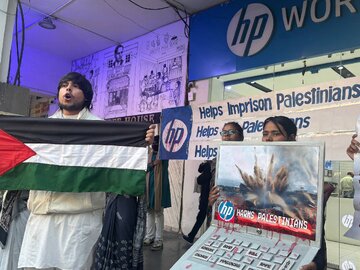
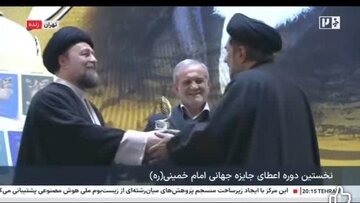
AhlulBayt News Agency (ABNA): Peshawar, Pakistan, hosted a grand gathering commemorating the martyrdom of Grand Ayatollah Seyyed Ali Khamenei (r.a.). Thousands of followers of the resistance front and the Islamic Revolution, alongside scholars, prominent Shia and Sunni figures, and Iranian diplomats, gathered at the Martyr Arif Hussain al-Hussaini Seminary in Peshawar to honor the memory of the martyred Leader of the Ummah. This ceremony was a rare scene of solidarity, empathy, and a display of unity among followers of different Islamic schools of thought in Khyber Pakhtunkhwa province in mourning for the martyred Leader of the Ummah.
Speakers at this gathering emphasized themes such as the unity of the Islamic Ummah, countering the policies of the United States and Israel, continuing the path of resistance, supporting the Islamic Republic of Iran, and stressing commonalities between Shia and Sunni.
Many speakers described the martyrdom of the "Martyr of the Ummah," Grand Ayatollah Seyyed Ali Khamenei, as a historic point for greater convergence of Islamic currents, emphasizing that the enemies of Islam sought to divide the Islamic Ummah, but this martyrdom, on the contrary, has led to greater unity among Muslims.
Senator Raja Nasir Abbas Jafari, the head of the Majlis Wahdat-e-Muslimeen (MWM) in Pakistan, stated, "The martyrdom of Grand Ayatollah Seyyed Ali Khamenei has united the Ummah, and today Shia and Sunni stand together against hegemonic projects."
He emphasized, "The United States and Israel seek to occupy the Islamic Ummah with internal divisions, but the resistance axis and the current of Islamic unity will not allow these goals to be achieved."
The head of MWM in Pakistan also stressed the necessity of practical unity among Islamic schools of thought and countering the policy of "divide and rule."
The Culture of Ashura: A Model of Resistance for the Islamic Ummah Against Enemy Aggression
Hojat al-Islam Mohammad Amin Shahidi, the head of the Ummah Wahida (Single Ummah) of Pakistan, also stated in his speech that this gathering is a symbol of Islamic awakening and a sign of the living nature of unity-oriented thought in Pakistan.
Continuing his remarks, he said, "The path of resistance does not stop with the martyrdom of leaders, and the Islamic Ummah must, inspired by the culture of Ashura and resistance, stand against oppression and aggression."
This prominent religious scholar emphasized the need for cooperation between Shia and Sunni scholars and the preservation of a fraternal atmosphere in Pakistan.
Hojat al-Islam Syed Iftikhar Hussain Naqvi, the head of the Imam Khomeini (r.a.) Foundation, also referring to the historic role of the Islamic Republic of Iran in supporting the cause of Palestine and defending the Islamic Ummah, said, "Today, the issue of unity is a strategic necessity for the Islamic world."
He added, "The enemies of Islam seek to use the media to intensify religious differences, but gatherings like this conference show that the Islamic Ummah remains united around the axis of resistance and the defense of sanctities."
Ali Banafsheh-Khah, the Consul General of the Islamic Republic of Iran in Peshawar, expressed gratitude for the widespread presence of the people and scholars, describing this gathering as reflecting the depth of the spiritual and intellectual relations between the peoples of Iran and Pakistan.
He emphasized, "They were unaware that the thought and beliefs of resistance, based on the doctrine of the noble religion of Islam, are ingrained and flowing in the blood and flesh of the Iranian people and our fighters. The pure blood of our martyred Leader has brought awareness and enlightenment to the Islamic Ummah."
The Consul General of Iran noted, "Let the enemy know that the Muslim nation of Iran has not yielded to the enemy's crimes and will stand firm to the end. Today, Iran is more determined than ever to cut off the hands of foreigners, including criminal America, from the region and the Persian Gulf."
Banafsheh-Khah emphasized, "Today, we have all come to the certainty that Islamic countries do not need American military bases or the presence of foreign Western military forces and mercenaries to establish borrowed security on their lands."
Islamic Unity: A Necessary Strategy in the Current Situation
In this gathering, a number of Sunni speakers also attended and emphasized the need to preserve unity among Muslims and counter extremism and sectarian seditions.
Sunni speakers described the issue of Palestine, the defense of Islamic sanctities, and countering American and Israeli domination as common issues of the Islamic Ummah, and called for greater convergence among Islamic currents.
The atmosphere of this gathering was accompanied by unity-inspiring slogans, support for the Islamic resistance, condemnation of U.S. and Israeli policies, and tribute to the martyrs.
Participants, holding images of resistance leaders and Islamic flags, emphasized continuing the path of the martyrs and preserving Islamic unity.
**************
End/ 345E