
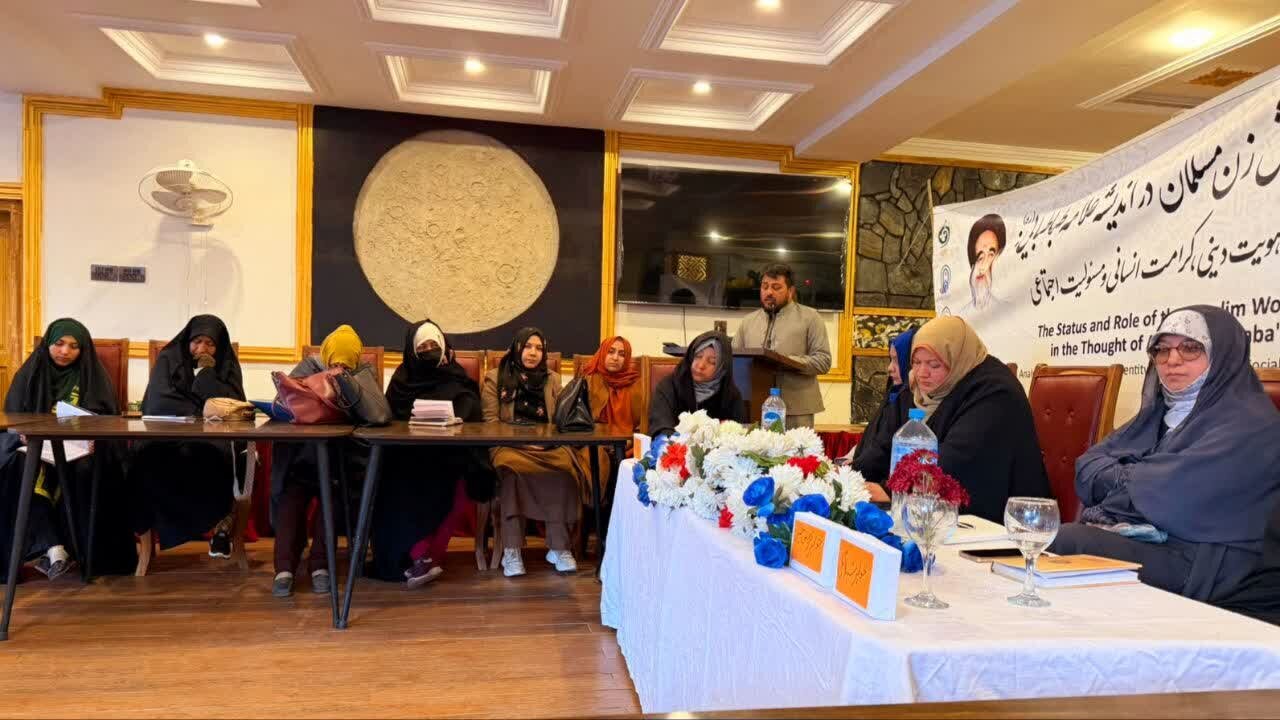
AhlulBayt News Agency: A scholarly and intellectual session titled “Muslim Women in the Thought of Allama Tabatabai: Identity, Dignity and Social Responsibilities” was held in Skardu to mark the death anniversary of Allama Syed Muhammad Husayn Tabatabai (R.A.). Female scholars from various fields participated in the session and discussed different academic, intellectual, Quranic and social aspects of the subject.
The event was jointly organised by the Research Department of Al-Mustafa International University Pakistan, Al-Zahra College, Bint-ul-Huda and Mishal-e-Noor.
The session followed an interactive question-and-answer format, with each scholar responding to various questions in the light of Allama Tabatabai’s thoughts and his renowned Quranic exegesis, Tafsir al-Mizan.
At the beginning of the programme, Ms. Laila Gul, Director of Al-Zahra College Skardu, delivered the opening remarks. She said that women's status, rights, human dignity and role within the family and society are important subjects that need to be understood in the light of Islamic teachings.
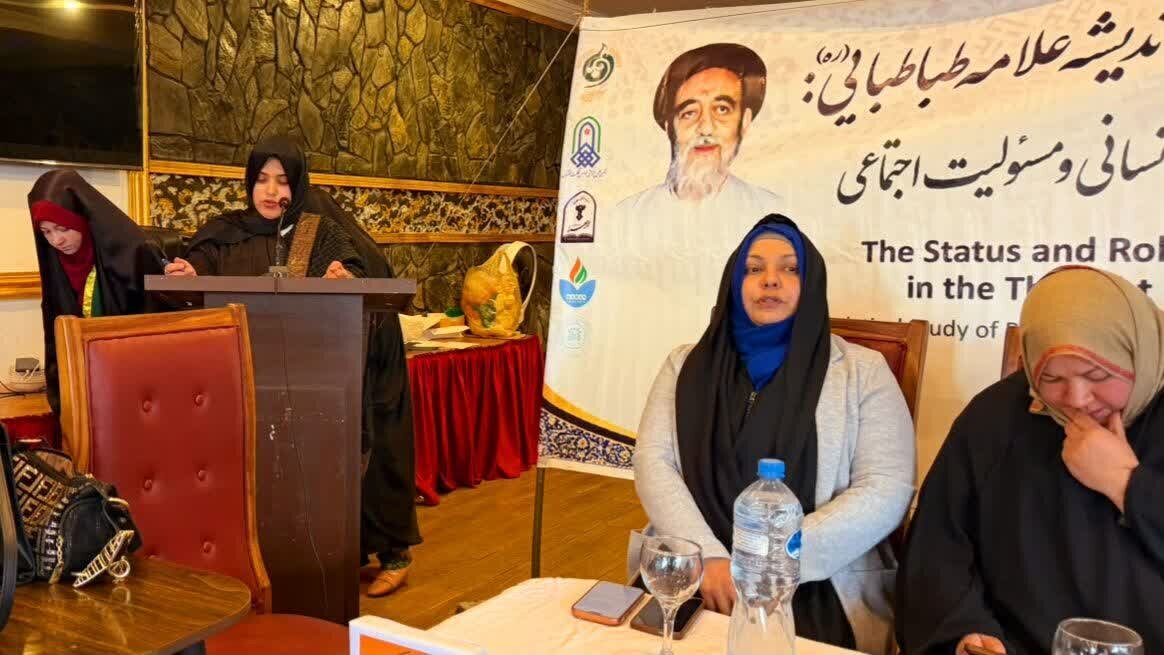
Explaining the key themes of the session, she said discussions would cover women's rights in Islam, human dignity, their position in family and society, participation in leadership and governance, collective decision-making, autonomy, Shariah-based rights, and their social and religious responsibilities.
She expressed hope that the session would help address misconceptions about women's status and promote a better understanding of the Islamic perspective.
Speaking on “Women's Autonomy, Shariah Rights and Social Responsibilities,” Islamic scholar Ms. Nargis Hussaini said that Islam recognises women as independent, dignified individuals with their own rights. She emphasised that, according to the Holy Quran, the standard of human excellence is not gender but faith, piety and righteous deeds.
Referring to Allama Tabatabai's Quranic interpretations, she discussed women's economic independence and said that Islam grants women the right to inheritance, dowry (mahr), personal property, business activities and control over their own earnings. She added that men's responsibility to provide financial support does not undermine women's economic independence.
Ms. Nargis Hussaini also referred to the Quranic account of the Queen of Sheba, highlighting women's political and administrative capabilities and their role in decision-making. She noted that the Quran establishes piety as the standard of human excellence and assigns both men and women the responsibility of contributing to social reform.
She further stressed that modern Muslim women should maintain their religious identity while actively participating in education, research, teaching, administration, economic activities and social reform. She cited the intellectual insight of Hazrat Fatima Zahra (S.A.) and the intellectual steadfastness of Hazrat Zainab (S.A.) as exemplary models for women.
She emphasised that empowering women does not require distancing them from their religious identity. Rather, it requires sound religious knowledge, intellectual awareness, understanding of their rights and access to practical opportunities.
Islamic scholar Najma Karimi, speaking on “Women's Status and Human Dignity in Islam According to Allama Tabatabai,” said that a woman's honour and merit in Islam are determined not by gender or family status but by faith, piety, character and righteous actions. She added that both men and women have the capacity to attain spiritual perfection, divine knowledge and closeness to God.
She explained that a woman is not worthy of respect merely in her roles as a mother, wife or daughter; she also possesses an independent human, moral, legal and social identity. The lives of Hazrat Hajra (S.A.), Hazrat Maryam (S.A.), Hazrat Asiya (S.A.), Hazrat Khadija (S.A.), Hazrat Fatima Zahra (S.A.) and Hazrat Zainab (S.A.) offer numerous examples of women's contributions to scholarship, religious outreach, leadership and social reform.
Ms. Karimi also discussed marital rights, describing marriage as a mutual contract. She addressed issues including divorce, khula, delegated authority to initiate divorce and a woman's right to establish permissible conditions at the time of marriage. She said that respecting women's consent, legal protection and autonomy within marriage is fundamental to a just family system.
She also highlighted the social and emotional implications of polygamy, the shared responsibilities of men and women within families, and the need for appropriate arrangements to ensure women's dignified participation in religious gatherings. The discussion also touched upon women's spiritual connection and permissible alternative forms of worship during menstruation.
Islamic scholar Zareena Tabassum spoke on “Islam and Polygamy,” explaining the conditions governing polygamy and the importance of justice and fairness in the light of Allama Tabatabai's Quranic interpretations.
Referring to Islamic teachings, she said that Islam permits men to marry more than one woman under specific conditions, with justice and fairness being the fundamental requirement. If a man fears that he will be unable to treat multiple wives justly, he should limit himself to one marriage.
Drawing on Tafsir al-Mizan she explained the two dimensions of justice: emotional and practical fairness. While complete equality in love and emotional inclination is beyond human control, men are responsible for ensuring fairness in financial maintenance, accommodation, marital rights and other obligations.
Referring to the meaning of verses 3 and 129 of Surah An-Nisa, she explained that the justice required in polygamy concerns practical and legal rights that are within human control, whereas complete equality in emotional affection is not possible. However, she stressed that emotional preference must not lead to neglecting one wife's rights.
She further stated that, according to Allama Tabatabai's Quranic interpretation, Islam makes polygamy conditional upon justice and fairness, with the primary requirement being the protection of women's rights, dignity and security.
The session concluded with an emphasis on the Islamic understanding of women as complete human beings, possessing dignity and serving as active members of society. Participants stressed the importance of recognising women's intellectual, moral, spiritual and social abilities and providing them with appropriate opportunities to fulfil their roles in the light of Islamic teachings.

Your Comment