
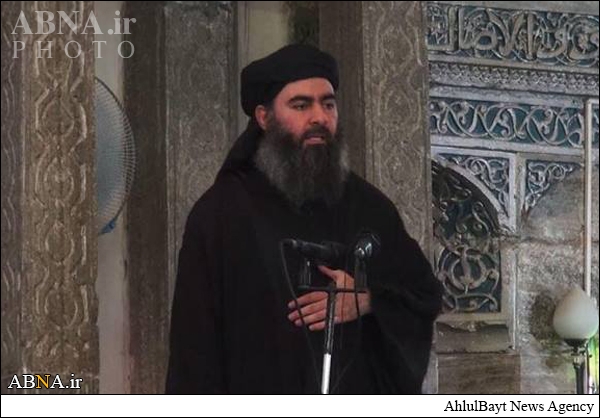
Dressed in black from head to toe, and wearing a flowing robe, this is the first image seen in years of the world’s most wanted man, whose terrorist group has butchered thousands and stolen more than a billion pounds in gold and cash.
Abu Bakr al-Baghdadi, the elusive leader of the Al Qaeda splinter group Islamic State of Iraq and Sham (Isis), walked out of the shadows and delivered a sermon at the Great Mosque in Mosul, Iraq’s second largest city.
He addressed the packed congregation – which included Isis fighters and local sympathisers – on the first Friday of the Muslim holy month of Ramadan, in the heart of a city his fighters took control of barely a month ago.
His sermon came only days after he declared himself caliph, or ruler, of the world’s 1.2 billion Muslims. He also declared large swathes of northern Syria and Iraq seized by his fighters as his new caliphate.
A video of Baghdadi’s sermon was released on the internet yesterday and went viral instantly on jihadist forums and websites.
Speaking from the pulpit of the mosque, Baghdadi, 42, urged the world’s Muslims to flock to the new Islamic caliphate. He praised the victory of his 14,000 fighters spread across Iraq and Syria.
The speech was an audacious move for a man who has a £6 million bounty on his head and who would be a target of attacks by drones or US forces.
Until yesterday, there were only two known images of Baghdadi. They were at least four years old and taken by US soldiers when he was in detention in Iraq.
When he became leader of Isis in 2010, he forbade any images or videos of him being issued, and experts have said that he even met some of his closest aides with his face covered, fearing spies.
Until he delivered his Friday sermon, intelligence experts were not even sure which country he was in, some claiming he was in Syria, while others said he may have been in Iraq.
Raffaello Pantucci, a security expert at the think-tank RUSI, said: ‘The video is emblematic of the confidence that Baghdadi and Isis feel about themselves.
‘They have consolidated a large part of Syria and Iraq into what they call a caliphate, and he is asserting his leadership.’
Last month Isis began an onslaught in northern Iraq, taking over Mosul and Tikrit, Saddam Hussein’s birthplace.
They executed hundreds of soldiers, and raided the city’s bank of cash and gold bullion.
They boast 11,000 fighters in Iraq and Syria and 3,000 foreign jihadis, including 500 Britons.
Last night, the Iraqi government issued a statement casting doubt that the video Isis issued was of Baghdadi.
Iraq’s interior ministry spokesman, Saad Maan, said: ‘We have analysed the footage, and found it a farce.’
The Iraqi government claims Baghdadi was injured in an air strike earlier in the week.
Baghdadi is believed to have been born in the Iraqi city of Samarra in 1971, and joined the insurgency against the US military following the 2003 invasion that ousted dictator Saddam Hussein.
He spent time in a US military prison and eventually took over leadership of a group, then affiliated with al-Qaeda and known as the Islamic State of Iraq, in 2010.
At the time, the group was believed to be on the ropes but Baghdadi led it back to prominence.
Last year, the organisation expanded into Syria, becoming a major player in the war to oust President Bashar al-Assad.
Baghdadi subsequently cut all ties to al-Qaeda and his influence now rivals that of that group’s global chief, Ayman al-Zawahiri.
IS is known for its brutality and executing and crucifying opponents. Photographs also emerged on Saturday showing its militants demolishing Sunni and Shi’ite mosques and shrines in Mosul and surrounding Nineveh province.
Iraqi security forces wilted when faced with the initial IS-led onslaught, and while they have since performed more capably, they have struggled to retake territory from insurgents.
An assault on Saddam’s hometown of Tikrit has gone on for more than a week without retaking the city, while a suicide car bomb killed 15 people on Friday near the sensitive shrine city of Samarra.


/149



