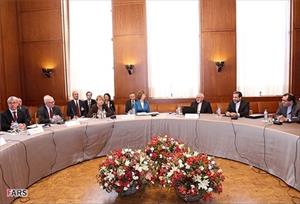
(Ahlul Bayt News Agency) - The second session of the talks started at the UN offices in the European city at 14:30 (Geneva time) and lasted for over two hours after a rather successful session of negotiations in the morning which lasted for nearly two hours. Iranian Deputy Foreign Minister Seyed Abbas Araqchi headed the Iranian delegation and EU Foreign Policy Chief Catherine Ashton's Deputy Helga Schmidt represented the world powers in the afternoon talks.
The Iranian delegation is comprised of Deputy Foreign Minister for European and American Affairs Majid Takht Ravanchi, Deputy Foreign Minister for Legal and International Affairs Seyed Abbas Araqchi, Foreign Ministry's Director-General for the Economic and Specialized International Affairs Hamid Ba'eedinejad, Legal Advisor to the Foreign Ministry Davoud Mohammadnia, and Mohammad Amiri from the Atomic Energy Organization of Iran (AEOI).
In the morning session, Zarif started the talks on the Iranian side and presented Tehran's new package of proposals to the opposite side, but he would not attend the afternoon session, and Araqchi would take the lead for the Iranian side. Zarif has announced that he would come back to lead the Iranian team in the talks when his counterparts from the Group 5+1 take part in the negotiations. At present, the talks are held at the level of deputy foreign ministers.
Following the morning session, Araqchi, who is also the spokesman of the Iranian team, told reporters that "the negotiations were held in a highly positive atmosphere and the two sides were serious when speaking of their issues".
Asked about Iran's new package of proposals, Araqchi said the package is "confidential" and the two sides have agreed to keep it secret until an agreement is made.
"Mr. Zarif had a powerpoint presentation of the plan in details, the generalities of the plan were discussed in the morning session and the details will be studied by (the two sides') political directors in the afternoon," he added.
Araqchi said that the world powers have welcomed the general points of Tehran's proposals on the settlement the country's nuclear standoff with the West, adding that Iran is seeking to encourage the opposite side to pursue a common goal for the negotiations.
"The Group 5+1 member states welcomed the generalities of Iran's plan," Araqchi told reporters.
He noted that the two sides will decide the date for the next round of talks, which, he said, will likely be in the next month, in their Tuesday afternoon and Wednesday sessions.
Araqchi said that Iran and the world powers should take certain steps for the settlement of Tehran's nuclear issue, and added, "The time of these steps should be specified because Iran does not want to move in an ambiguous atmosphere."
He also stressed that Iran has defined a common goal for the negotiations, and said, "Unlike the previous meetings that every side entered the negotiations to attain its own goals, this time we will try to design a common goal and then move towards it."
Araqchi expressed the hope that the representatives of Iran and the G5+1 would be able to make a decision on the date of the next round of the talks between the two sides during the Tuesday afternoon and Wednesday sessions.
Zarif, heading a high-ranking delegation, left Tehran for Geneva on Monday and held a dinner meeting with Ashton last night.
Iran and the world powers held a meeting on the sidelines of the UN General Assembly session in New York in September and decided to meet again in Geneva on October 15-16.
Zarif announced last week that he and his negotiating team are going to offer a new set of proposals during the Geneva talks.
“I will put forward a new plan to resolve the dispute over Iran’s nuclear activities during the next round of talks with the Group 5+1,” he said, without elaborating on the contents of the new plan.
Late in September, Iranian President Hassan Rouhani underlined that his government has full authority from Supreme Leader of the Islamic Revolution Ayatollah Seyed Ali Khamenei for talks with the world’s six major powers.
“The government has sufficient authority to gain substantial results in talks with the Group 5+1,” President Rouhani told reporters at a press conference in New York on the sidelines of a UN meeting where he also held phone talks with US President Barack Obama.
“The government has the necessary authority in nuclear talks and I have chosen the foreign minister for negotiations,” he added.
The Iranian president pointed to the September meeting of foreign ministers of Iran and the six world powers in New York, and said, “The meetings of Dr. Zarif with G5+1’s foreign ministers were held in a positive and inspiring atmosphere and we hope that these talks could soon bear tangible results.”
Iran and the G5+1 have had several rounds of talks in the last few years. Before the New York meeting, representatives of the seven countries had two days of intensive negotiations in Almaty on April 5 and 6, but without making any major breakthrough.
Prior to the Almaty II talks, Iran and the six powers had met in Almaty on February 26-27.
Also, between the two rounds of Almaty talks, experts from Iran and the G5+1 reviewed the two sides' proposals in a meeting in Istanbul from March 17 to 18. The two sides' experts also outlined the topics of the talks between the chief negotiators of Iran and the G5+1 for the Almaty II meeting.
Prior to Almaty, Iran and the G5+1 had held three rounds of talks in Geneva, two rounds in Istanbul, one round in Baghdad and one round in Moscow in June 2012.
In Baghdad talks on May 2012, Iran offered a comprehensive package of step-by-step proposals to the six world powers. The Iranian step-by-step proposals offered practical steps to the western sides.
Iran also presented a package of proposals to the world powers in May 2009 offering collective cooperation in resolving major world issues.
The 2009 package of proposals which was presented by the then Iranian Foreign Minister, Manouchehr Mottaki, to the ambassadors and representatives of the six major powers was an all-embracing package offering cooperation between Iran and the West on solutions to a wide variety of global issues.
Iran's ex-chief negotiator and Supreme National Security Council (SNSC) Secretary Saeed Jalili led the Iranian side during the last few rounds of talks with the G5+1 while delegations of the world powers were headed by Catherine Ashton. But following the June presidential election in Iran, which sent Dr. Hassan Rouhani to power, Tehran decided to change its team of negotiators and entrusted the leading role in the negotiations to Zarif and his team, although the SNSC still continues coordinating the talks.
Tehran has also replaced Jalili in the SNSC Secretariat with former Defense Minister Rear Admiral Ali Shamkhani. Jalili is now a member of Iran's Expediency Council (EC) which is chaired by former President Akbar Hashemi Rafsanjani.
/149