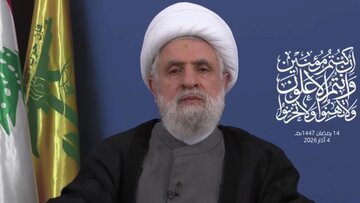
AhlulBayt News Agency (ABNA): The Speaker of the Lebanese Parliament stated that instead of relying on the regional process supported by Tehran, Lebanese officials went to Washington for mistaken unilateral negotiations to bring a ceasefire, but instead of a ceasefire, they brought war with Hezbollah.
The Lebanese government has received leaked news about the possibility of a ceasefire in Lebanon with great caution. While circles around President Joseph Aoun sought to suggest that they had information about American pressure on Israel at Lebanon's request, related to the meeting two days ago in Washington between the Lebanese ambassador and the Israeli ambassador under U.S. supervision, Western and Hebrew media revealed something else.
According to these media outlets, the American pressure aims to impose a one-week ceasefire in Lebanon, not directly related to the recent Israel-Lebanon meeting in Washington, but rather connected to ongoing negotiations in the region.
Although information published until last night indicated that Tel Aviv had rejected the American request to include Lebanon in the ceasefire agreed upon with Iran, this demonstrates the enemy's desire to continue the escalation of military tension in Lebanon.
A Lebanese newspaper published a report stating that the Lebanese ambassador to the United States, Nadi Hamadeh Maawad, had sent a brief report to the Prime Minister's office and the Lebanese Ministry of Foreign Affairs regarding the details of the Washington meeting, while dedicating a detailed report containing additional information to the presidential palace.
Meanwhile, Nabih Berri, the Speaker of the Lebanese Parliament, does not hide his distress and dissatisfaction with the action of the President and Prime Minister and their engagement in the path of direct negotiation with the Israeli enemy.
In one of his meetings with Lebanese officials, he reiterated his firm opposition to any direct negotiation with Israel, emphasizing that the priority should remain a ceasefire, the consolidation of internal peace, and preventing deviation toward internal strife.
He notes that this position is not new; rather, he has expressed it many times, most recently in the statement of the leadership body of the Amal Movement a few days ago, and also in the statement of the movement's executive body the day before.
Reacting to the statement issued after the meeting between the Lebanese ambassador and the enemy Israeli ambassador in Washington, Berri told Al-Akhbar, expressing astonishment at the path taken by Lebanese officials, saying, "They went to America to bring a ceasefire, but returned to fight Hezbollah!"
He added that refraining from participating in a negotiating process within the framework of a broader regional process and going into unilateral negotiation without holding power cards weakens Lebanon's position instead of strengthening it.
**************
End/ 345E