
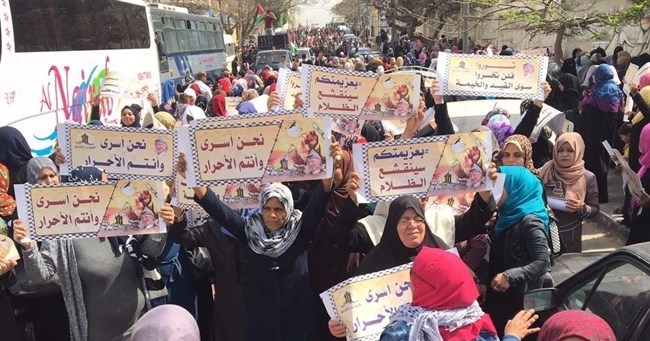
In Gaza city, thousands of Fatah-affiliated Palestinians marched from al-Katibeh Square in western Gaza to the al-Saraya Square in the center of the city in solidarity with hunger-striking Palestinian prisoners.
Protesters came from different areas of the besieged Gaza Strip and repeated slogans calling for more solidarity campaigns to support the prisoners, while waving Palestinian flags.
Fatah-affiliated lawmaker Naimeh al-Sheikh said that marches would continue in Gaza until the prisoners’ demands are met. She added that despite the issues that the Gaza Strip is currently facing, Gazans will insist on standing with the hunger strikers.
Legislative council member of the Fatah movement Majed Abu Shammaleh called upon Palestinians to support the prisoners with their fight waged “with empty stomachs” to improve their conditions in Israeli prisons.
Abu Shammaleh added that Palestinians imprisoned by Israel are in the most need of support and solidarity, which can also put pressure on Israeli authorities to help the prisoners reach their goals.
“What the prisoners are currently fighting for, and what some will pay the price for, is the least requirements of human life,” Abu Shammaleh said, adding that their demands could seem “normal” to some, but it would make a “real difference” for the prisoners to have decent meals, a cover during the cold months, a visit from a relative, or even a book to read.
Abu Shammaleh called upon international Palestinian and Arab societies to get involved in actions to support the prisoners, including pressuring embassies and ambassadors to support the hunger strike.
Meanwhile, in the southern Israeli city of Beersheba, the southern Islamic movement held a solidarity sit-in for Palestinian hunger strikers in front of the Islamic cemetery.
Head of the movement, Sheikh Hammad Abu Daabes, lawmaker Abd al-Hakim Hajj Yahya, head of the movement in the Negev Kamal Haniyeh, and the head of the Higher Guidance Committee for Arab residents of the Negev Said al-Kharrumi all took part in the sit-in.
Al-Kharrumi said that the “prisoners’ cause is our people’s first cause and their battle is the battle of our people.”
On Friday night, dozens of Palestinians in the West Bank city of Bethlehem lit candles in the Nativity Square in solidarity with the hunger strikers.
Participants gathered near a sit-in tent that had been erected in the square in support of the hunger strike, while local leaders delivered speeches on the importance of continuing solidarity actions and supporting the Palestinian prisoners until their demands are met.
Meanwhile, demonstrations were held across the occupied West Bank, including East Jerusalem, Israel, and among the diaspora in Syria on Friday to support the hunger strikers, with thousands of Palestinians participating.
Initially called for by Fatah-affiliated prisoners, Palestinian prisoners from across the political spectrum have since pledged their commitment to undertake the strike, with the media committee of the “Freedom and Dignity” strike estimating that some 1,500 prisoners have been forgoing food.
The hunger strikers have denounced the torture, ill treatment, and medical neglect of Palestinian prisoners at the hands of Israeli authorities, as well as Israel’s widespread use of administrative detention -- internment without trial or charges -- which is only permitted under international law in extremely limited circumstances.
Israeli authorities have detained approximately one million Palestinians since the establishment of the state of Israel in 1948 and the subsequent occupation of the West Bank, East Jerusalem, and the Gaza Strip in 1967, according to a joint statement released last week by Palestinian organizations.
According to prisoners' rights organization Addameer, some 6,300 Palestinians were held in Israeli custody as of March.


/257



