
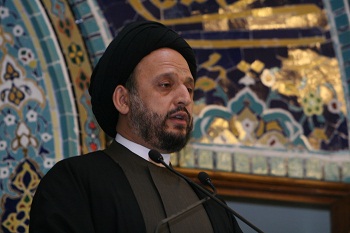
His Eminence, Sayyed Ali Fadlullah, delivered the two Friday prayer sermons at the Imamain Al-Hassanain Mosque, Shawwal 5th 1435 H. – July 1st, 2014. Several prominent religious scholars, dignitaries and thousands of believers attended the Jumu’a prayer.
Following is a summary:
The First Sermon
In the first sermon, His Eminence, Sayyed Ali Fadlullah, talked about building strength that is deemed in Islam a duty and not a choice. He elaborated on all kinds of physical and moral strength and concentrated on the power of speech in the age of social media where everybody can publish his own opinion.
He said that it is truly the age of information in which we are fighting an informational war against an enemy that is well-inversed in this art. However, we can win this war if we base our potentials on education, training, awareness and truthfulness in what we say and propagate.
The Sayyed ended his speech by warning that although we need to build our strength to face the arrogant and the occupiers, yet such strength, without any moral restrictions, becomes a kind of tyranny and oppression. Thus, when we want to use the power of speech to respond to what our opponents say, we should not resort to cursing and the like. Our speech should be moral and truthful. Speech is a very strong weapon, especially nowadays, where the balance of military force is not in our favor and where the enemy receives a lot of financial and political support. As such, we need to know how to develop our informational abilities, just as those who are engaged in warfare prepare themselves for war.
The second sermon
In the second sermon, His Eminence, Sayyed Ali Fadlullah, began by praising the steadfastness of the resistance in Gaza, in spite of all the brutality and savagery of the enemy that enjoys the support of the West, while the Arab and Muslim worlds remain silent.
He said that we are not in the position of lecturing this heroic resistance on what it should do, for it has proved its ability of giving lessons to the others. In the meantime, we ought to remind the Arab and Muslim worlds to shoulder their responsibilities of supporting the Palestinians, even if just with tears, and not justify - as some have done - the crimes, massacres and aggressions of this enemy. We also call for freezing all the secondary differences, for Palestine is the major cause, and when Palestine falls, no Muslim or Arab country will remain safe and secure.
In Iraq, amid the dangers that threaten the unity of the country and the inability to form a government, the Sayyed called on all partiers to accept the results of the parliamentary elections.
He also considered that what is happening particularly in Mosul and generally in Iraq represents a threat to all Iraqis, both Muslims and Christians, and they should unite to face such threat.
As for Lebanon, the Sayyed called for stabilizing the country so as not to be influenced by what is happening in Syria and Palestine. Stability, the Sayyed noted, cannot be established except by an internal reconciliation, which is the responsibility of the politicians who should hasten to establish it.
/149



