
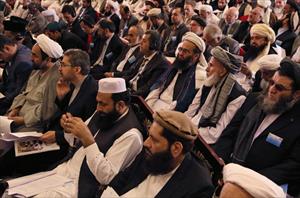
(Ahlul Bayt News Agency) - Hundreds of Islamic scholars from across the Muslim-majority world have gathered in Kabul to discuss the ongoing conflict in Afghanistan.
The International Conference of Islamic Scholars and Peace, which began on Tuesday, is being viewed by many as the latest in a series of steps towards peace in the Central Asian nation.
"Their wisdom, guidance and experience will be extremely useful in having a dialogue to change the narrative of violence to one of peace," Massoom Stanikzai of the High Peace Council, the meeting’s organising body, said of the more than 200 Islamic scholars gathered at Kabul’s Intercontinental hotel.
The conference of scholars from more than two dozen countries came days after Pakistan released Mullah Abdul Ghani Baradar, the Afghan Taliban’s number two, in an effort to aid the peace process.
But several scholars told Al Jazeera that the Taliban was operating in reverse.
"Fighting must be a last resort, but [the Taliban] started on the battlefield … they should have sat with their nation … [But] you can’t start by force of the gun to kill women and men and children," said Sheikh Muhammad Faalah Altayi, adviser to the speaker of Iraq's parliament.
Dr Ahmad Azhare, president of the Dawat Academy International Islamic University in Islamabad, said Islam never allowed for an individual entity to come to the decision to fight, and suggested the ulema should "make the Taliban sit for dialogue".
Though they all agreed Islam forbids the killing of innocent civilians, scholars who spoke to Al Jazeera were reluctant to say outright that suicide bombings were un-Islamic.
The gathering, originally scheduled for November in Pakistan, faced several delays after Pakistani religious leaders refused to issue an order outlawing the use of suicide attacks.
In March, Tahir Ashrafi, the head of the Pakistani Ulema Council, made waves across Kabul when he told Afghan media suicide bombings were permitted so long as foreign forces remained in Afghanistan.
"Palestine is occupied by Israel, Kashmir by India, and Afghanistan by the US. So if the Muslims don't have the atomic bomb, they should sacrifice their lives for God," he said.
Scholars at the Kabul meeting took a different view.
Azhare, the Pakistani representative alluded to the suicide attacks, when he told Al Jazeera "whatever is happening, whether its Afghanistan, Pakistan or anywhere else - if women and children, ordinary citizens are being killed Islam forbids it".
/149



