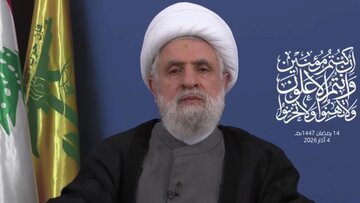
AhlulBayt News Agency (ABNA): Coinciding with the anniversary of the victory of the Islamic Revolution of Iran, an online session titled “47 Years of Progress and Power” was held on Tuesday, February 10, 2026, with the participation of international experts, by the AhlulBayt (a.s.) World Assembly.
At the beginning of the session, Hojat al-Islam Esmaeili welcomed the guests and referred to the progress, independence, and self-reliance of the Islamic Republic of Iran over nearly half a century. He stated that “over the past five decades, the civilized people of Iran have become a symbol of steadfastness for all free and monotheistic peoples of the world.”
At the outset of the online meeting, Dr. Fouad Izadi, a faculty member and dean of the Faculty of World Studies at the University of Tehran, delivered a speech addressing “the successes and failures of the Islamic Republic over the past 47 years.”
Izadi stated that one of the reasons behind the Iranian people’s revolution and the overthrow of the Shah’s regime was that “the Shah was anti-Islamic.” Consequently, he said, “Islamic discourse under the leadership of Imam Khomeini (r.a.) became united to bring an end to years of monarchical rule in Iran. Therefore, one of the principal aims of the Iranian people, who are overwhelmingly Muslim, was to terminate an anti-Islamic regime and establish an Islamic government.”
He added, “The Shah’s regime was overthrown through a popular revolution, and an Islamic government was established. However, this did not mark the end of the process, as the establishment of an Islamic government represents only the beginning of the path, and the crucial matter lies in appointing individuals committed to Islamic principles.”
He described this as one of the shortcomings of the Islamic Republic, noting that the overthrow of an anti-Islamic government does not automatically result in the establishment of a fully Islamic system. He further stated that efforts to establish such a government inevitably provoke opposition from anti-Islamic groups and individuals. As he explained, in the early days following the victory of the Islamic Revolution, separatist operations were carried out in various parts of Iran by groups that, according to later documents, were supported by the United States.
The university professor continued that approximately one and a half years after the victory of the Islamic Revolution, the Ba’athist regime of Iraq, with U.S. support, launched an attack against Iran. In this regard, he recommended that audiences consult the book From Ally to Adversary, written by the military attaché of the U.S. Embassy in Iraq.
According to Izadi, one of the major forms of U.S. assistance to Saddam’s regime involved providing aerial imagery to the Iraqi army to identify the disposition of Iranian military forces. He further said that the United States supplied Saddam with chemical weapons and, following chemical attacks by Saddam’s regime against Iranian forces, provided updated aerial images to enable more precise bombardment of Iranian positions.
Izadi also identified another challenge facing the Iranian people as the university faculty, many of whom, he asserted, had been shaped by Western culture and operated in line with Western objectives. The Muslim people of Iran, he said, realized that replacing these Western-oriented academics would not be an easy task. Thus, he described the Islamic Revolution as the first and most significant step, while confronting subsequent challenges, including the eight-year imposed war, constituted the next stage.
He emphasized that prior to the revolution, the leaders of the government were corrupt, whereas after the revolution its leader, Imam Khomeini (r.a.), was a gnostic figure who lived a simple life. While the Shah was portrayed as corrupt, Imam Khomeini was presented as a model of Islamic ethics.
Izadi further stated that the new generation of Iranian officials, who, due to their age, neither experienced Imam Khomeini nor witnessed the eight-year imposed war, have nonetheless become aware of the successes and failures of the Islamic Republic through study and documentation. He described this as one of the achievements of the Islamic Republic: its ability to transmit its message to the younger generation, a task he characterized as difficult given what he described as U.S. dominance in media warfare and propaganda.
He noted that one of the questions raised by American think tanks concerns how the Islamic Republic has continued to endure. In light of U.S. propaganda, he argued, maintaining a system founded upon Islam is extremely challenging. As an example, he referred to the government supportive of the Muslim Brotherhood that came to power in Egypt and was overthrown by a military coup after approximately one year. By contrast, he asserted that the Islamic Republic of Iran has continued to exist and will persist, attributing this endurance to the Iranian youth.
In conclusion, Dr. Izadi thanked the audience for their attention and stressed the necessity of drawing lessons from both the successes and failures of the Islamic Republic, asserting that such reflection would lead to further achievements.
Following Dr. Izadi, Ms. Marzieh Hashemi delivered remarks as the second speaker of the session. She began by congratulating “the entire Islamic Ummah” on the forty-seventh anniversary of the victory of the Islamic Revolution, stating that, in her view, “this revolution belongs to the entire Ummah.”
She added that the victory of the Islamic Revolution in Iran prompted her to begin studying Islam, ultimately leading to her conversion to Islam at the age of 27. She stated that media outlets at the time had emphasized that the revolution would not endure and would ultimately fail. According to her, Western media initially portrayed the revolution as evil and, in her words, even spread falsehoods about it in an explicit manner. She maintained that this trend continues today, asserting that when she asks people in different countries about Iran, they, under the influence of Western media, believe that the Islamic Republic is a police state that has achieved no progress. She further identified portrayals of women’s marginalization in the Islamic Republic as another consequence of such media influence. By contrast, she stated that, as an American woman living in Iran, she witnesses the daily progress of Iranian women, which she said is less evident in the United States.
Addressing what she described as the West’s extensive expenditure on media campaigns against Iran, Hashemi argued that the reason lies in Western fear that Iran could become a model for the world. She stated that even when speaking with people in Islamic countries, they express surprise at the progress of the Islamic Republic, as they too have been influenced by media narratives. She further claimed that Western media are engaged in shaping global public opinion through systematic influence.
She also emphasized the significant impact of the Islamic Republic of Iran’s support for Palestine. According to her remarks, following the war of the Israeli regime against the people of Gaza, what she described as genocide in the region, and the Islamic Republic’s support for Palestine, including operations known as “True Promise I and II”, people around the world were able, in her view, to witness which side represents the truth.
Continuing her remarks on the status of women in the Islamic Republic, she stated that more than 33 percent of university entrants in Iran are women, 44 percent of scientists in the medical field are women, and 24 percent of Iranian inventors are women, approximately ten percent higher than the global average. She questioned how, in light of such figures, global public opinion perceives Iranian women as oppressed.
At the conclusion of the session, some participants raised questions which were addressed by the experts. During the middle segments of the program, informative video clips concerning the Islamic Revolution and its achievements were also broadcast in English.
**************
End/ 345