
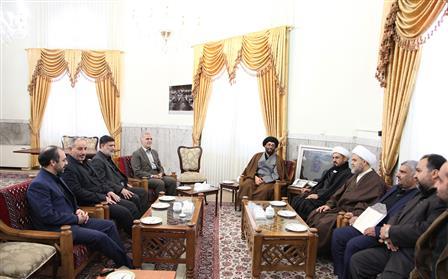
The authorities of Astan Quds Razavi and the holy shrine of Imam Hussein (A.S.) visited each other at the Razavi Holy Shrine and exchanged their ideas for having more contact to give better services to the pilgrims.
In this session which was held with the presence of Astan Quds Razavi’s assistant of Islamic Relations and Propagations, assistant of sacred premises and pilgrims’ affairs, and the supervisor of the general office of public relations, the deputy of great custodian of Imam Hussein’s (A.S.) Shrine expressed his happiness for being in Iran and visiting the Holy Shrine of Imam Reza (A.S.) and said: Enjoying Astan Quds Razavi’s experience, undoubtedly, can have significant role in rendering best services to the pilgrims of Iraq’s holy sites.
Seyed Afzal remarked: The great congress of Rabi al-Shahadah will be held in the near future and in this trip to Iran we will officially invite Astan Quds Razavi’s authorities to take part in this gathering.
Welcoming the servants of Imam Hussein’s (A.S.) holy shrine, the assistant of Islamic relations and propagations of Astan Quds Razavi stressed: Visiting the sacred premises in Iraq by millions of pilgrims is a unique capability to introduce the pure Islam to the world people.
Referring to the importance of taking the advantage of pilgrimage, Hujjat al-Islam wa al-Muslimin Seyed Jalal Husseini remarked: The relations and cooperations of the sacred premises ‘organizations is much more than what it was in the past and this important issue can form many political, social and cultural relations.
He said: Gathering about 20 million devoted pilgrims on the Day of Arbaein of Imam Hussein (A.S.) made all the social and political analysts surprised and made it clear for the world people that love and affection to the Imams (A.S.) is not limited to the geographical boundaries.
At the end, the secretary of the Supreme Cultural Council of Astan Quds Razavi emphasized: Making the services more effective and promoting the quality of them is an issue which has always been attended to and it is necessary to develop them quantitatively and qualitatively.
/257



