
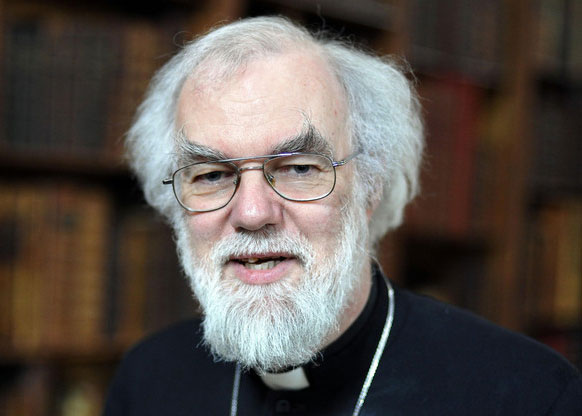
The former Archbishop of Canterbury has voiced support to Muslim primary school teachers’ right to don full-face veil or niqab, saying that “panic” about the religious outfit is “largely misplaced”.
“As I learn a language, I learn not only to identify objects, I learn how to interact with another speaker,” former Archbishop of Canterbury, Lord Rowan Williams was quoted by The Telegraph.
“We all know what happens when people don’t learn that, when they speak without a sense of the codes that are operating – the tone, the timbre, etc.
“I suppose that’s what panics people about, let’s say, a primary school teacher wearing the face veil.
“As a matter of fact I think that’s largely a misplaced anxiety, but I can see where it comes from.”
In an interview for the Christian think-tank Theos, the former Archbishop reopened the debate about niqab in the British public life.
The religious attire, donned by a few number of British Muslims, sparked a political storm last year after the then Home Office minster, Jeremy Browne, called for a national discussion about restrictions in some settings such as schools to prevent young women from having the veil “imposed” on them.
David Cameron rejected the idea of a ban but said he would “back up” schools and courts that ask women to remove veils.
This is not the first time the Archbishop has supported the right of Muslim women to wear hijab.
In 2006, Lord Williams warned that a British ban of the face-veil (niqab) and other religious insignia would be "politically dangerous".
In 2008, he called for adopting aspects of Islamic Shari`ah law in Britain to improve community relations, saying the United Kingdom had to "face up to the fact" that some citizens do not relate to the British legal system.
His latest remarks come amid an-depth academic discussion about his latest book, The Edge of Words, which examines the meaning of words and language in discussions about God.
“I’ve actually been in public discussions in Pakistan with women wearing full face veil, and you learn to read differently, it’s not that those codes don’t happen … but there’s a cultural obstacle to overcome,” he said.
Britain is home to nearly 2.7 million Muslims.
Islam sees hijab as an obligatory code of dress, not a religious symbol displaying one’s affiliations.
As for the face veil, the majority of Muslim scholars believe that a woman is not obliged to cover her face or hands.
Scholars, however, believe that it is up to women to decide whether to take on the veil.
/149



