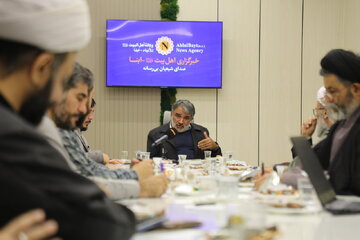
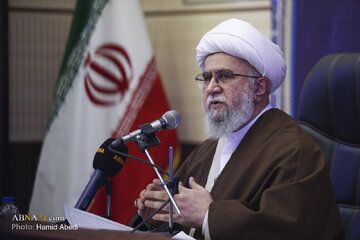
AhlulBayt News Agency (ABNA): Ayatollah Reza Ramezani, in a mourning ceremony on the morning of the sixth day of the month of Muharram, while elucidating the view of the AhlulBayt (a.s.) regarding the reality of life and death, said that to understand the way of life of Imam Hussein (a.s.), one must first understand life and death themselves, because one's way of life is based on our understanding of the reality of life.
Referring to the fact that lifestyle is one of the important and far-reaching topics of today, he stated that in the statement of the Second Phase of the Revolution, lifestyle has also been mentioned as one of the important recommendations, and it can be regarded as the software of the new Islamic civilization.
Ayatollah Ramezani added that the Supreme Leader of the Revolution has outlined stages for the movement of the Islamic Revolution, including the Islamic Revolution, the Islamic system, the Islamic government, the Islamic country, and ultimately the new Islamic civilization, and lifestyle plays a fundamental role in the realization of this civilization.
Emphasizing that both life and death are divine creations, he specified that the Holy Quran states that God created death and life. If the reality of life is properly understood, then the duty of the human being on the path of life and death will also become clear.
The Secretary-General of the AhlulBayt (a.s.) World Assembly, stating that the root of the human being is divine, said that the verse “Indeed we belong to God, and indeed to Him we return” is one of the important educational verses, because it shows both the beginning of the human being and his end. The human being is from God and returns to God.
He continued that God has created the human being as a great being with a lofty station, such that many of the creatures and facilities of the world have been created for the benefit of the human being. Therefore, the goal of the human being should not be worldly and superficial matters, because these matters are for the human being, not that the human being is for them.
Ayatollah Ramezani, referring to the view of the sages, said that the human being is noble, and a noble human being should not make his goal base and worldly matters, but rather his gaze should be toward higher stations. If we confine life to food, clothing, wealth, and superficial matters, we have lost the reality of life.
Ramezani, stating that the AhlulBayt (a.s.) did not perform worship for Paradise or Hell, added that their worship was for God; not for being seen, not for reward, and not out of fear of punishment. In their worship, they did not see themselves, worship, Paradise, or Hell, but rather only saw God.
Referring to the levels of worship, he stated that we may, in our worship, both seek God and desire Paradise or fear Hell, but the worship of Imam Hussein (a.s.) and the AhlulBayt (a.s.) was at a level in which nothing but God was seen
Ayatollah Ramezani added that in supplications such as Kumayl and Abu Hamzah, the human being utters words whose reality is very difficult to attain, such as that punishment may be bearable, but separation from God is not bearable. These are very lofty teachings that the AhlulBayt (a.s.) have taught us.
The speaker of the ceremony, referring to four fundamental relationships in human life, said that the AhlulBayt (a.s.) have taught us that a correct life is based on four sound relationships: the relationship with God, the relationship with oneself, the relationship with others, and the relationship with existence. If these relationships are properly understood and regulated, the human being has won life, otherwise he has lost it.
He considered the relationship with God as the first relationship and said that worship must be solely for God, not for being seen. If the human being worships for God, he will be seen, not only in the realm of the visible world, but also in the realm of the invisible.
Ayatollah Ramezani, referring to the conduct of Imam Hussein (a.s.), said that Imam Hussein (a.s.), even in the most difficult scenes, saw God and spoke in his final prostrations with satisfaction and submission before God. When Lady Zaynab (a.s.) was asked about Karbala, she said, “I saw nothing but beauty.”
He added that this perspective is understood when the reality of life is known. As long as we do not properly understand life, we cannot understand how someone, amidst so much tragedy, sees Karbala as beautiful.
The Secretary-General of the AhlulBayt (a.s.) World Assembly, referring to the station of Imam Hussein (a.s.), said that after the martyrdom of Imam Hussein (a.s.), the world went into mourning; the sky became clouded, and the inhabitants of the Throne and the earth, both humans and jinn, all wept for him. The name of Hussein (a.s.) is not only mentioned on earth, but also flows in the Throne and the realm of the invisible.
He considered the relationship of the human being with himself as the second important relationship and said that the human being must make peace with himself and know himself. The AhlulBayt (a.s.) taught us that before taking care of others, we should take care of ourselves; we should take care of our eyes, tongue, heart, and behavior.
Ayatollah Ramezani stated that the best ruler is one who is the commander of his own soul. One who is captive to carnal desires cannot be the commander of others. The human being must first free himself from the captivity of the soul.
Stating that the value of the human soul is very high, he said that the least price of the human being is Paradise, and its highest level is where God becomes the purchaser of the human being. The AhlulBayt (a.s.) made the best trade and made God Himself their reward.
The member of the Assembly of Experts of the Leadership added that if God loves a servant, He tests him with affliction. Imam Hussein (a.s.), in all states, whether when he was in the arms of the Prophet (p.b.u.h) or when he was in Karbala in the utmost state of oppression, praised God.
Referring to the profound expressions of the supplications, he said that the divine human being reaches a point where he considers God as his life, his death, his world, and his hereafter, and says, “O my life, O my death, O my world, O my hereafter.”
Ayatollah Ramezani continued that God is close to the human being and accompanies him in all scenes. Just as Prophet Abraham (a.s.), when thrown into the fire, sought help from none but God, the believing human being should also know that God sees him and is aware of his condition.
He added that this perspective is not only relevant in the individual sphere, but also has meaning in the social and political arena. The Holy Quran teaches the believers not to weaken in the face of the enemy and not to grieve, because if they are believers, they are superior.
The Secretary-General of the AhlulBayt (a.s.) World Assembly, referring to the role of knowledge in understanding death, said that when the human being understands the reality of life, he also understands the reality of death. In the school of Imam Hussein (a.s.), death and martyrdom are given such meaning that Hazrat Qasim (a.s.), in response to Imam Hussein’s (a.s.) question, says that death for me is sweeter than honey.
He added that this understanding is the result of upbringing in the school of Imam Hussein (a.s.). A youth who has been raised alongside the Imam sees death on the path of truth as “sweeter than honey.”
Ayatollah Ramezani, referring to the story of Hazrat Ali Akbar (a.s.), said that when Imam Hussein (a.s.) on the road to Karbala uttered the phrase “Indeed we belong to God and indeed to Him we return,” Hazrat Ali Akbar (a.s.) asked why he had said this. The Imam replied that this caravan is the caravan of martyrdom. Ali Akbar (a.s.) asked, “Are we not on the path of truth?” The Imam replied, “Yes.” He answered, “Then we have no fear of death.”
In conclusion, he prayed for the recognition of the reality of the human being and said that the human being must know his divine root. Sometimes we are ourselves afflicted, and before being afflicted by others, we are afflicted by our own souls. The gatherings of Imam Hussein (a.s.) should undo our existential knots, revive our hearts, and acquaint us with our own reality and our divine root.
Ayatollah Ramezani noted that if the human being understands in these gatherings that his root is divine and his return is also to God, he will understand the reality of life and death and will better recognize the path of the AhlulBayt (a.s.).
**************
End/ 345