AhlulBayt News Agency (ABNA): The city council elections in the industrial city of Vigevano in northern Italy have revealed rifts and disagreements within the country's ruling right-wing parties regarding immigration. This came after the presence of Muslim candidates on the right-wing's electoral lists in these elections sparked widespread controversy among supporters of these parties.
Vigevano, surrounded by old factories and rice paddies and about an hour from Milan, has a population of nearly 62,000. About 15 percent of the city's residents were born outside Italy, and many others have obtained Italian citizenship. A part of Vigevano's population is also made up of second-generation immigrants.
This medium-sized city, once a stronghold of the communist current in Italy, prospered through the shoe industry but has faced the decline of this industry in recent years.
The far-right Lega party, a member of the ruling coalition led by Italian Prime Minister Giorgia Meloni, has administered this city for the past 16 years. Party members won in the first round of the 2020 elections, but in late 2024, following corruption allegations, the mayor of Vigevano was suspended.
However, in the recent elections, the results of which were announced on Monday evening, the Lega party suffered a heavy defeat, winning only 21.45 percent of the vote and failing to advance to the second round. These results were announced by the Italian Ministry of Interior.
In contrast, the left-wing parties, which entered the competition as a unified coalition, took the lead with 34.31 percent of the vote and advanced to the second round—a stage that will determine the final composition of the Vigevano city council.
Breaking Stereotypes
Riccardo Ghia, a jeweler and Lega party candidate for the Vigevano city council, made headlines in late April when he included two Muslim candidates on his electoral list.
Three days before the vote, on the last day of campaigning, he declared in Vigevano's main square, "Anyone who respects the rules is a full citizen with all rights."
This is while the Lega party has traditionally been known for its tough stance against immigration and defense of Western values.
Many party supporters, accustomed to anti-immigration and anti-Islam slogans, did not welcome the candidacy of Ibrahim Hussein, the spokesperson for the local mosque.
Ibrahim Hussein, in a post on Facebook beginning with "In the name of God," explained that he chose the Lega party because he sees himself as a successful example of integration and coexistence in Italian society.
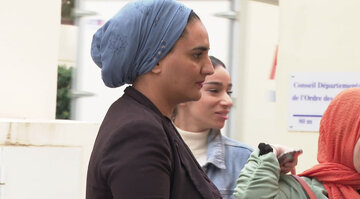
The other Muslim candidate, Hajar Hajjaj, of Egyptian origin, announced that since being introduced as a candidate, she has faced a wave of threats and insults, especially for wearing the hijab.
The 20-year-old, who entered the elections at the Lega party's suggestion, said she liked the local party team and its programs.
She also emphasized that she had never personally been a victim of racist behavior and pointed to the good relationship of Vigevano's former mayor with the Muslim community—a mayor who agreed to allocate a space for Muslim worship in 2022.
In her remarks, Hajar Hajjaj stated that her goal is to break the stereotype of the ignorant, leftist Muslim woman.
She is currently studying diplomacy at university and has not ruled out entering politics in Egypt.
Disruption of Political Equations
The central leadership of the Lega party distanced itself from this local electoral list, announcing it bore no responsibility for it, although the list was supported by Prime Minister Giorgia Meloni.
Now, Riccardo Ghia, who failed to advance to the second round, must negotiate with a list supported by Forza Italia, another member of the ruling coalition, to win seats on the Vigevano city council. This party came second in the first round with 24.38 percent of the vote.
These internal disagreements have benefited a new current led by Roberto Vannacci, a former Italian army general. He split from the Lega party and founded the more far-right party Futuro Nazionale (National Future).
This emerging far-right figure appeared in Vigevano's main square on May 17 and delivered a harsh speech against immigration.
Furio Soffia, a lawyer and candidate supported by this party, focused his electoral program on security. He proposed deploying the army to Vigevano to counter groups of youth present around the train station, as well as closing the Muslim place of worship.
This party achieved one of its best results in Italy in Vigevano, winning 14.21 percent of the vote.
Immigrants and the Future of Italian Politics
As Italy prepares for next year's general elections, its society has become more multi-ethnic than ever, and second-generation immigrants are gradually gaining more political weight.
However, candidates with immigrant backgrounds still have a small share in Italian elections—a country where large waves of immigration are a more recent phenomenon compared to countries like France and Germany.
Maurizio Ambrosini, a sociologist at the University of Milan, says many right-wing parties in Italy have tried to change traditional political equations in recent years by recruiting candidates from immigrant families.
He also emphasizes that many immigrants with Italian citizenship are also drawn to right-wing currents, similar to what has been seen among some Latin American immigrants supporting Donald Trump in the United States.
**************
End/ 345E