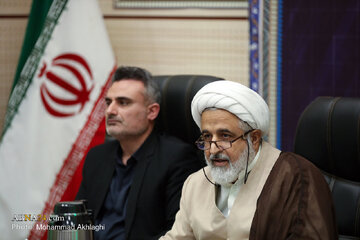
AhlulBayt News Agency (ABNA): A critical review session of the book "The Extension of the School of the Two Imams of the Revolution Under the Leadership of Ayatollah Seyyed Mojtaba Hosseini Khamenei: Characterization and Response to Doubts" was held on Tuesday, May 12, 2026, with the presence of a group of scholars and experts in Islamic and political sciences. Held in the meeting hall of the AhlulBayt World Assembly, the session focused on analyzing the intellectual dimensions, governance conduct, and responding to doubts surrounding the new Leader of the Revolution, where professors presented their views on the critique and explanation of the content of this forthcoming publication.
Explanation of the Book's Structure in Three Main Axes
At the beginning of the session, Hojat al-Islam Dr. Piri, as the presenter of the work, explained the overall structure of the book. He stated that the book is compiled in three sections and three chapters. The first chapter examines the historical and discursive journey of the leadership, beginning from the time of Imam Khomeini (r.a.) and, passing through the era of the "Martyred Imam," culminating in the leadership period of Ayatollah Seyyed Mojtaba Hosseini Khamenei, analyzing the 47-year developments of the Revolution in various fields.
Hojat al-Islam Dr. Piri dedicated the second chapter to characterization and added, "In this section, based on in-depth interviews, three axes are discussed: scientific and jurisprudential personality, social personality and interaction with elites, as well as his governance experiences learned from the 'Martyred Imam.'" He also noted that the third chapter addresses the doubts raised mainly by hostile media regarding his leadership.
Leadership: A Qur'anic and Transnational Movement
Hojat al-Islam Dr. Najaf Lakzaei, head of the Research Institute of Islamic Sciences and Culture, described the position of leadership strategically as a continuation of the movement of divine prophets. Citing verse 13 of Surah Al-Shura, he emphasized that "our leaders are first and foremost 'Qur'anic leaders'" and that they reconstruct the school of Islam within the framework of revealed teachings. He noted that in this view, leadership is not limited to the borders of a single country but is a transnational and global matter for guiding followers of religion worldwide.
Dr. Lakzaei considered the great success of the leadership to be the upbringing of a generation he called "civilization-thinking and jihad-thinking." He stated, "The record of the leadership is success in raising a people who recognize the enemy and understand the movement of Wilayah; a generation that, even without directly seeing the deputy of the Imam, moves behind him with insight." He suggested that in future editions of the book, the level of discussion should be elevated toward more strategic and Qur'anic analysis.
The Necessity of Precise Scholarly Citations and Audience Differentiation
Following the session, Hojat al-Islam Dr. Saeed Solhmirzaei, a member of the Assembly of Experts, while appreciating the speed of compilation of this work, critiqued some technical aspects. Referring to the concept of the "1,200-year-old human," he described the leadership of the Imams of the Revolution as a continuation of the movement of Shia leaders during the Occultation and emphasized the need to explain the behavioral principles of governance, such as religious democracy.
Hojat al-Islam Dr. Solhmirzaei raised some criticisms, saying, "The book must clarify its target audience; sometimes the language is highly specialized and jurisprudential, difficult even for advanced-level seminary students, and at other times it becomes more general."
He also emphasized the need for more precise citations in the section on the jurisprudential school, adding that one should not be content with making claims without providing sources and exact references from his lessons and writings. He also suggested using more of the new leader's messages and views on the personality of the "Martyred Imam" to better understand the trajectory of the new leadership.
An Affirmative Approach to Responding to Doubts and a Civilizational Perspective
The final speaker, Hojat al-Islam Dr. Ahmad Kowsari, pointed to the strengths of the book as the first authored work in this field. He praised the structured and problem-oriented approach of the book but called for more emphasis on topics related to the new Islamic civilization and the resistance front, saying, "His role in Shia-Sunni unity and support for Palestine as the main issue of the Islamic world should be further explained."
Dr. Kowsari warned against the dominance of a defensive approach in the doubts section and suggested, "Instead of directly raising doubts, which may become ingrained in the reader's mind, facts should be explained in an affirmative and persuasive manner so that the reader is immunized before being exposed to the doubt."
In the concluding part of his remarks, he emphasized that to maintain the emotional and ideological bond between the people and society, it is appropriate to use the term "Imam" for the Leader of the Islamic Revolution from the very beginning, because Wilayat al-Faqih is an extension of Imamate.
It is worth noting that the physical copy of the book "The Extension of the School of the Two Imams of the Revolution Under the Leadership of Ayatollah Seyyed Mojtaba Hosseini Khamenei: Characterization and Response to Doubts" has not yet been published in the market.
**************
End/ 345E