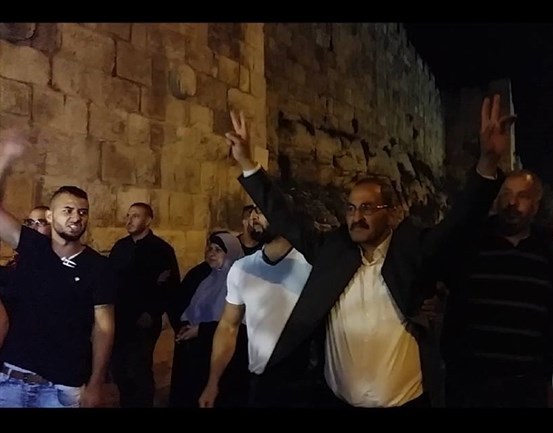
(AhlulBayt News Agency) - Israeli authorities returned the body of Palestinian Bahaa Elayyan on Thursday at dawn, allowing his family to bury him 325 days after his death.
Elayyan, a 22-year-old resident of the East Jerusalem neighborhood of Jabal al-Mukabbir, was killed alongside another Palestinian after they attacked an Israeli bus on Oct. 13, killing three Israelis with knives and a gun.
His body was buried at the al-Mujahidin cemetery near the Old City of Jerusalem, in accordance with stipulations from Israeli police, which has allowed the release of bodies of slain Palestinians from East Jerusalem accused of "terrorism" on the condition that they no longer have funerals in their neighborhoods or villages, but would instead be buried in cemeteries chosen by the police.
The stipulation comes amid a wider set of preconditions for the release, as only 25 people were allowed to attend Elayyan’s funeral, and his family was made to pay a 20,000 shekel ($5,292) “insurance fee” to make sure they abided by the rules.
Israeli forces were heavily deployed in the area ahead of the funeral, as attendees were searched three times at checkpoints and saw their phones confiscated during the burial. Israeli forces also reportedly prevented people who were not on the submitted list from entering the cemetery.
Israeli police also reportedly photographed people inside the cemetery.
“One of the most difficult moments in life is for parents to bury their children,” Muhammad Elayyan, Elayyan’s father, told reporters. “Israel holds the bodies of martyrs as a policy to punish parents and pressure them.”
A lawyer and activist, Muhammad Elayyan has spearheaded a movement by the families of slain Palestinians demanding that Israeli authorities return the bodies, said that his son’s body was severely altered by the long period of time it had spent frozen in Israeli morgues.
“Since the body was held in freezers for ten months, substantial changes occurred to Bahaa’s features and color,” Muhammad Elayyan said. “his eyes sunk inside his skull as if he did not have any, muscles atrophied and his skin peeled off easily.”
“It was difficult to identify him; except that I am his father and I know him well,” he added.
Muhammad Elayyan said that there were three bullet marks on Bahaa’s body, including one in the chest, near the heart.
The United Nations released a report in May stating that Israeli authorities have prohibited autopsies from being conducted on Palestinian corpses, and that the bodies were kept in poor and inhumane conditions, “stacked on top of each other.”
“The bodies returned to the families are often disfigured, sometimes beyond recognition, denying the families the right to accord, with dignity, final religious rites,” the report read.
Nonetheless, Muhammad Elayyan said that he and Elayyan’s mother were able to say their last goodbyes to their son before the burial.
“We had loving moments with Bahaa and words would ruin these moments,” he said.
Mourners remembered Elayyan as a socially involved young man who was invested in cultural activities in East Jerusalem. He was described as a scout leader, the founder of an initiative called “Town’s Youth,” and one of the organizers of a “reading chain” around the walls of the Old City of Jerusalem in 2014.
Israeli authorities continue to hold the bodies of 12 slain Palestinians accused of committing attacks against Israelis, including including three women and two residents of occupied East Jerusalem, among them Abd al-Muhsen Hassuneh, 21, and Muhammad Abu Khalaf, 20.


/257