
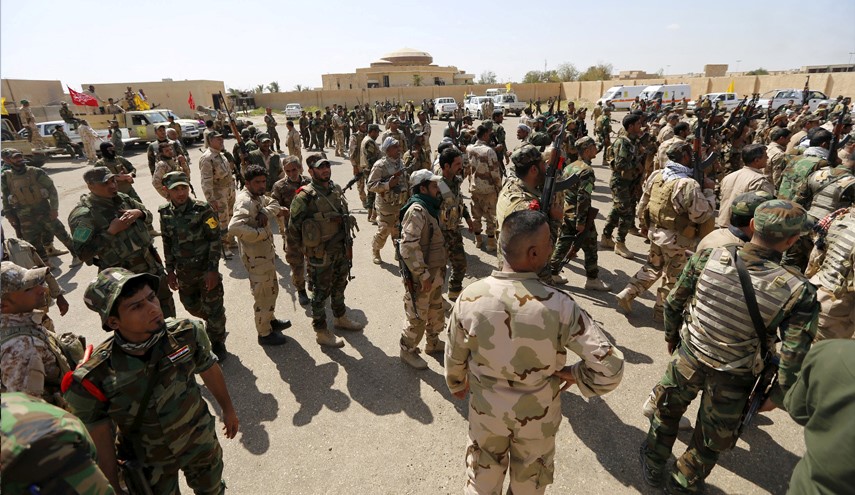
(AhlulBayt News Agency) - Two Jan. 2 attacks left several security officers dead and resulted in a shoot-out lasting into the next day. On Jan. 17, the directorate of military intelligence announced that they arrested the man who had coordinated the attack two weeks earlier with a variety of weapons and explosive materials intended for being used in future attacks in Samarra.
The local media chief for the group said, it does not allow other Popular Mobilization Units (PMU) into the area without prior permission after an agreement with the government.
Samarra, roughly 130 kilometers (81 miles) north of Baghdad and 70 kilometers (43 miles) south of Tikrit, is widely known for a 2006 attack on the Al-Askari Shrine revered by Shiites. ISIS leader Ibrahim Awad Ibrahim al-Badri al-Samarrai, more commonly known as Abu Bakr al-Baghdadi, was born in 1971 in a village nearby.
On Jan. 2, in addition to the two attacks on police stations in Samarra, a suicide bomber drove into a fruit and vegetable market in Sadr City. The Baghdad attack killed at least 36 people, many of them day laborers.
Saraya al-Salam’s black Humvees with a logo featuring a dove (Saraya al-Salam translates to Peace Brigades) against a flag-adorned map of Iraq logo are ubiquitous in Samarra and frequently seen in cities nearby. Colorful posters commemorating the "martyrs" of the war against ISIS terrorists line the streets and decorate checkpoints.
The group was formed by Sadr after terrorists took Mosul in June 2014; it has been key to the success in many battles alongside other PMUs.
"Saraya al-Salam is very selective," Emad Abu Moaml, one of the group’s fighters deployed to the city, told us. "We ask the people from their area what sort of person they are and reputation they have before accepting them. We received orders from Sayyid Muqtada al-Sadr to protect civilians who are suffering and their property."
The group claims to attach great importance to giving inhabitants back the money, gold and property they found when they entered the city.
One Saraya al-Salam fighter told us that, prior to their taking responsibility for the security of the city, many inhabitants had buried their valuables and money to prevent theft.
"We found millions of dinars and gold," another fighter, Karim al-Zeidi, said while showing us cellphone photos of stacks of money and gold jewelry. In regard to the dangers they are exposed to, he noted, "We lost 13 of our men in the explosion of one home here, when we entered a booby-trapped house to secure it. The family wanted to go in but we wouldn’t let them until our men had made sure that it was safe."
Keeping people’s property intact is "even more important than fighting terrorists," he said, stressing that they had sometimes made decisions during the fighting not to target homes, even if they knew an terrorists were there, to prevent the loss of property.
The head of media for Saraya al-Salam in Salahuddin province, Mohannad al-Azawi, told us that the fighters in the city did not receive payment of any sort. He said he was able to afford to do this since he receives payments as part of a law that compensates those injured by "acts of terrorism and military mistakes."
He said, "[I was injured] fighting the US occupation in 2008 in Baghdad," as part of Jaish al-Mahdi, Saraya al-Salam’s predecessor. Many others, he said, are government employees who are able to take off a few weeks at a time and use their holiday time to man the checkpoints.
The PMUs, which Saraya al-Salam is part of, have taken on military security duties in other areas and were granted "full legal status" with pensions and salaries by the government in November.
/106



