
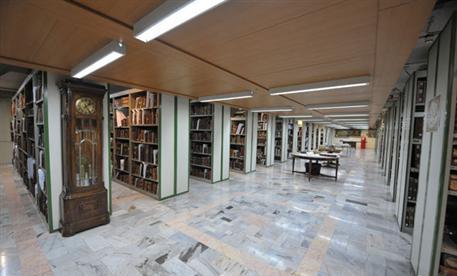
A unique collection of over 100 Qur’anic manuscripts made by the handwriting of the Infallible Imams (A.S.) inscribed on deerskin is on display in the treasury of handwritten manuscripts of Astan Quds Razavi.
Based upon the existing documents, director of treasury of handwritten manuscripts of Astan Quds Razavi remarked, “The available evidence in this organization indicate that Astan Quds Razavi as the oldest and the safest endowment institution has possessed extensive administrative systems, and the library of Astan Quds Razavi has been operating since the Safavid period.”
Noting that containing handwritten Qur’ans and books on different subjects such as Hadith, Fiqh, ethics, news, math, etc., the library of Astan Quds Razavi contains excellent samples of calligraphy art, book decoration, and bookbinding, FazelHashemi added, “By the invasion of the Ghiz and Uzbeks in the tenth century of hijrah, a number of these books and documents were destructed though.”
Referring to Qur’an manuscripts attributed to the handwriting of Infallible Imams (A.S.),dating back to the first century of hijrah, he added, “Also aexquisite collection of over 100 Qur’ans inscribed on deerskin attributed to the handwriting of the Infallible Imams (A.S.) in Kufi script is on display inthe treasury of handwritten manuscripts of Astan Quds Razavi.”
“Among the existing Qur’ans, there are also those attributed to Imam Ali (A.S.), Imam Hassan (A.S.), Imam Hussein (A.S.), Imam Sajjad (A.S.), Imam Musa Kazem (A.S.), Imam JafarSadeq (A.S.), and Imam Reza (A.S.) that dates back to the second century of hijrah inscribed in Kufi script”, director of treasury of handwritten manuscripts of Astan Quds Razavi said.
Regarding the historical trend of handwriting evolution he remarked, “The evolution trend of calligraphy started by Kufi script (close to Naskh script) and later continued with Ruqa, Thulth, Naskh, Touqi, Reihan, Muhaqqeq by Ibn-iMuqleh and Ibn-iBawab and after the talented calligrapher, YaqutMusta’semi, made his appearance, the Naskh script became fixed as the Muslims’ common script for writing the holy Qur’an.”
“Arbaein Jami by Sultan Ali Mashhadi’s handwriting in Arabic and Persian, prayers of the week by MuhammdShafi’ Tabrizi’s handwriting in NaskhMomtaz and Mabda’ and Ma’ad in Arabic, Me’rajnameh and AdviehQalbieh in Arabic related to the 7th century of hijrah scribed by Avicenna are among the exquisite works published as picture printing”, he explained.
director of treasury of handwritten manuscripts of Astan Quds Razavi also recounted the poetic incantation of Imam Ali (A.S.) inscribedin Nasta’liqMomtaz by Mir Ali Heravi in the tenth century of hijrah, as well as an exquisite Nahj al-Balaghah by YaqutMusta’semi’s handwriting in Naskh dated back to 800 years ago as remarkable handwritten works in the library of Astan Quds Razavi.
“The exquisite works of treasury of handwritten manuscripts of Astan Quds Razavi have been published in a few volumes titled as the artisticmasterpieces of Astan Quds Razavi, a selection of Qur’an manuscripts since the beginning to the 9th century of hijrah, publication 1392, and a second volume that includes an investigation on 10 to 14 centuries of hijrah, publication 1393, a selectionof Nasta’liqfragments from Moraqqa’at, and a selection of literary handwritten books by the Organization of Libraries, Museums, and Center of Deeds of Astan Quds Razavi and the Center of Artistic Creations of Astan Quds Razavi”, he added.
/257



