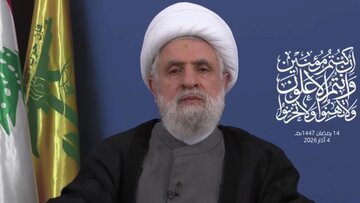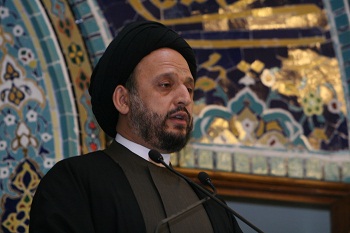
His Eminence, Sayyed Ali Fadlullah, delivered the two Friday prayer sermons at the Imamain Al-Hassanain Mosque, Shaaban 23rd 1435 H. – June, 21st 2014. Several prominent religious scholars, dignitaries and thousands of believers attended the Jumu’a prayer.
Following is a summary:
The First Sermon
In the first sermon, His Eminence, Sayyed Ali Fadlullah, talked about the congregational prayer, discussing the social element in the worshipping acts in Islam.
He explained that Allah has ordained these acts in a way that the closer to your fellow Muslims and the surrounding people; the closer you will get to Allah. Thus, worshipping is an act of sustainable development of social relations.
The Sayyed then talked about the social role of prayers, which reaches its highest level in the congregational prayer. He said that it is not merely a form of prayer. It plays an educational role at the social, political and economic levels, since it is performed in a daily and repeated manner and since it can be performed anywhere, even in one’s house, which consolidates the relations between the members of the family and the society in general. This social factor was reinforced in many legislations, such as the participation of women in the congregational prayer and the call for unity between sects through allowing it to be led by an Imam of a different sect.
The Sayyed called, in the end, for overcoming the circumstances and the conditions that were behind the diminishing status of the congregational prayer in our society, as in the act of tightening the conditions that should be available in the Imam leading the prayer and even considering him to be unjust if he just has a different political opinion.
The Sayyed concluded that the congregational prayer is a security valve to our society, which ensures that we overcome our selfishness and subjectivity and represents our means to reach the utmost spiritual level of closeness to Allah.
The second sermon
In the second sermon, His Eminence, Sayyed Ali Fadlullah, talked about the situation in Iraq. He explained that some groups are using sectarianism to weaken this country, thus undermining its role and unity.
He said that no party should believe that ISIS represents it or acts as a Trojan Horse that would enable it to achieve its goal in ruling Iraq or dividing it. Those who have this in mind are actually being illusionary, for they do not know what the real goals that ISIS was created to serve are.
On the other hand, he considered that indeed there have been mistakes in running the country and certain sects might not have attained their rights, but this does not justify what is happening. Thus, the Sayyed called for a political review of everything that has happened, and he asked all parties, whether religious or political, to rise to the level of dangers that Iraq is facing.
He considered that they should be wise and precise in their decisions, thus playing a role in extinguishing the fire and not fueling it. He also expressed his belief that the solution in Iraq is rather political than military; it should be based on dialogue that can consolidate the unity of the country.
The Sayyed also called on the countries that can influence the Iraqi internal parties to seek establishing calmness and dialogue, rather than inciting sectarianism and meddling in the Iraqi affairs, for the Iraqi sectarian fires will not be confined to the Iraqi boundaries.
In Palestine, the Sayyed expressed his fear that the Israelis might use the kidnapping incidents of some settlers as an excuse to expel some Palestinians from the country. He also called for internal unity and for thoroughly studying the demands of certain factions, especially that the Palestinian Authority still maintains its security coordination with the Israelis.
The Sayyed called the Lebanese political leaders to solve the social and living problems, which will have an impact on the security situation. He also called for electing a new president and for being more vigilant in view of the security risks.
/149