
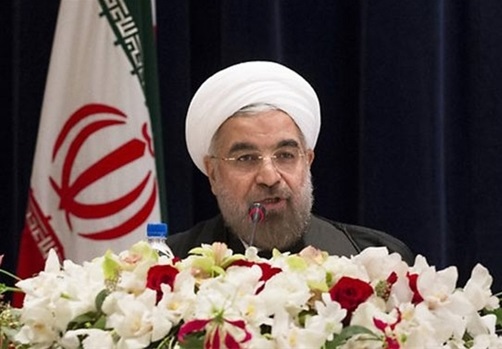
"In the past they accused us that we are terrorists, but after the new plan proposed by the government to the United Nations it became evident that we are against extremism and violence," President Rouhani said in a meeting with Ulemas and elites in the Western Ilam province.
On December 18, the UN General Assembly overwhelmingly voted to approve Rouhani’s World Against Violence and Extremism (WAVE) proposal, which calls on all nations across the globe to denounce violence and extremism. The Iranian president had made the proposal in his address to the UN Disarmament Conference in New York on September 25.
President Rouhani further told the meeting that fortunately Iran's proposal was unanimously approved at the UN and all those who unfairly accused Iran found out that Iran is not in pursuit of violence, and that all the previous accusations were baseless.
The Iranian president explained that for many years the US-led West claimed that Iran is after making atomic bomb, but today they sit to the negotiating table with the country's officials which shows all their accusations have been baseless. "The world today is forced to accept that the only way to deal with the Iranian nation is interaction and this nation does not bow to (their) pressure and sanctions."
He noted that the West should "pursue the path of logic, dialogue and negotiations because they do not have any other choice vis-a-vis the great and resistant nation of Iran".
Under the UN resolution adopted in accordance with the WAVE proposal, the General Assembly would urge member states to take “appropriate measures to strengthen universal peace and to achieve international cooperation in solving international problems of an economic, social, cultural, or humanitarian character”.
Iran and the Group 5+1 (the five permanent UN Security Council members plus Germany) started experts talks in New York on Tuesday.
The expert teams will wrap up their talks later today.
The experts' talks precede the fourth round of negotiations between the senior diplomats of Iran and the G5+1, which will kick off in Vienna on May 14.
Deputy chief negotiators from Iran and the sextet wrapped up their last round of talks in Vienna on April 9. The talks were headed by Araqchi and EU foreign policy deputy Chief Helga Schmidt.
The talks started on April 8 by a session presided by EU foreign policy chief Catherine Ashton and Iranian Foreign Minister Mohammad Javad Zarif at the UN headquarters in Vienna, and continued by a meeting among the deputy chief negotiators of the seven nations.
The Iranian Foreign Ministry in a statement on April 8 reiterated that its team of negotiators would not discuss any topic but the country's nuclear standoff with the West in its talks with the six world powers.
The talks between Tehran and the G5+1 are part of efforts to seal a final deal on Iran’s nuclear energy program.
Iran and the Group 5+1 representatives had several sessions of talks in Vienna on March 18-19 too. Following the breakthrough interim agreement between Iran and the six powers, the two sides accepted to send their senior negotiating teams to monthly meetings to discuss a final and comprehensive deal until July. If the seven nations fail to agree on a final deal by then, the Geneva interim agreement will be extended for another 6 months.
On November 24, Iran and the Group 5+1 sealed a six-month Joint Plan of Action to lay the groundwork for the full resolution of the West’s decade-old dispute with Iran over the latter's nuclear energy program.
In exchange for Tehran’s confidence-building bid to limit certain aspects of its nuclear activities, the sextet of the world powers agreed to lift some of the existing sanctions against Tehran and impose no nuclear-related sanctions on Iran during the six-month period.
/149



