
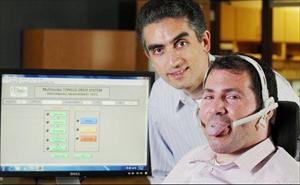
(Ahlul Bayt News Agency) An Iranian professor at Georgia Institute of Technology has installed a small magnet on the tongue because of its high flexibility to control the wheelchair for disabled people.
A new device shows that tongue piercings can be more than just an expression of one's style. They can also help those who have lost the use of their arms and legs move. In a recent clinical trial, the device, called the Tongue Drive System, performed much better than the most widely used system.
The study, which was led by Iranian Associate Professor Maysam Ghovanloo, from the Georgia Institute of Technology, was recently published in the journal Science Translational Medicine.
The most popular assistive technology for individuals with quadriplegia - also known as tetraplegia - to control a wheelchair is known as the sip-and-puff. With this method, users sip or puff air into a straw that is installed on their wheelchair.
This helps them send four basic instructions that drive the chair.
However, the Tongue Drive System is controlled by the placement of the user's tongue. A magnetic tongue piercing allows them to use their tongue like a joystick, and sensors in the piercing send the tongue's position to a wireless headset, which can then send six different commands to the wheelchair.
The idea for placing a magnet tongue piercing in the mouth of individuals with quadriplegia was created by Dr. Anne Laumann, from the Northwestern University Feinberg School of Medicine.
"Tongue piercing put to medical use - who would have thought it?" says Dr. Laumann. "It is needed and it works!"
A brief video below from Georgia Tech explains how the Tongue Drive System works.
/149



