

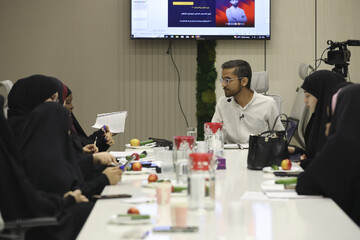
Ahlul Bayt (AS) International News Agency - ABNA: In an interview with ABNA correspondent Zainab Askari on the sidelines of the specialized screening, Masoud Taheri, the writer, director, and producer of "Ashab al Khair," elaborated on the research objectives and content structure of the documentary. He identified its central focus as explaining the historical process of the formation of the Shia belief community and the laying of its epistemic foundations during the period of Imam Baqir (AS) and Imam Sadiq (AS).
Watch the Documentary teaser:
Explaining the intellectual axes of the film, Taheri emphasized that the authentic Shia teachings and their epistemic foundations took shape at this historical juncture. In this work, he noted, the Shia belief community possesses a trans-spatial identity that is not limited to geographical or territorial boundaries but is instead based on intellectual, hadith, and doctrinal ties.
The main and special focus of the documentary "Ashab al Khair" is on the measures and actions of Imam Muhammad Baqir (AS). By examining the role of four of the distinguished and prominent companions of Imam Baqir (AS), the film depicts their historical position in the formation of the Shia hadith movement. These four prominent companions are Zurarah ibn A'yan, Muhammad ibn Muslim, Abu Basir al-Asadi, and Burayd ibn Mu'awiyah.
According to the director of the work, these four key figures are considered the source of the Shia hadith movement — a movement that expanded in subsequent centuries, crystallized in authoritative narrative texts including the book "Al-Kafi," and continued over the centuries until the time of the last prominent Shia hadith scholars, including Mirza Husayn Nuri (Muhaddith Nuri).
Taheri also explained the screening history of the documentary "Ashab al Khair," stating that the film's initial screening took place on January 11 (21 Dey), and that its screening process was halted due to developments and conditions in the country. He described the screening held at the Art Bureau of Qom as the first exclusive showing of the work for professors and elites, and announced that, according to plans made, this documentary will be screened in the future at other universities, scientific centers, and academic spaces, and will be reviewed and critiqued in specialized sessions.
Watch the Interview:


Your Comment