
ABNA24 - In a specialized meeting hosted by the Iranian Cultural Chancellery in Manila, the personality and intellectual dimensions of a leadership model were discussed, with an emphasis on culture, justice, and foresight.
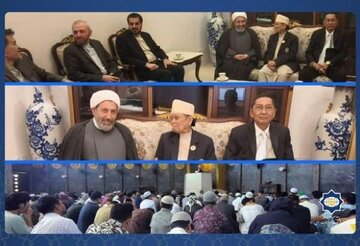
A specialized meeting titled "Reexamining the Personality, Intellectual, and Future-Oriented Dimensions of Seyyed Ali Khamenei and Explaining the Concept of Resistance and Unity as a Trans-religious Shared Value and a Model in Governance" was held in person and via webinar at the location of the Cultural Chancellery of the Islamic Republic of Iran in Manila.
The program began with the presence of a group of Catholic Christian men and women, as well as figures from Shia and Sunni Muslim communities from various cities in the Philippines. In the initial segment, exhibitions focusing on commemorating the martyrs of the Minab girls' elementary school (symbolically) were set up, and attendees participated by paying tribute to over 168 martyrs in a memorial space designed for this purpose. Additionally, a photo exhibition depicting the dimensions of the destructive war of the United States and the Israeli regime against the Islamic Republic of Iran and this school was presented.
Following that, the feature film "The Survivor" directed by Seifollah Dad was screened for the attendees. These segments provided a cultural backdrop for entering the main session and were well received by the participants.
Atefeh Noori, the acting head of the Cultural Chancellery of the Islamic Republic of Iran in Manila, in her remarks, explained the personality, intellectual, and future-oriented dimensions of the martyred Leader (Supreme Leader) and described him as a model of leadership in which personal ethics, social commitment, and a strategic view of the future are intertwined.
According to her, characteristics such as simple living, attention to culture, and close connection with the people play an effective role not only in personal life but also in the manner of governance, strengthening social trust and reducing the distance between the government and society. This approach emphasizes creating a balance between ideals such as justice and independence with the realities of the time, and considers culture as the foundation of sustainable transformation. Foresight within this framework means active planning to build the future with a focus on youth, science, and progress.
Noori, referring to the challenges of governance in the contemporary world, emphasized the necessity of strengthening the two concepts of "resistance" and "unity." These two concepts were introduced as complementary and trans-religious values that can form the basis for a balanced model of governance; a model that, while maintaining internal cohesion, also enables effective interaction with the international environment.
In this meeting, a number of thinkers and experts from scientific, religious, and cultural fields delivered speeches. Among them were Commissioner Robert Alonto, Dr. Mansour Limba, Professor Tirmizi Ismail Abdullah, Priest Erahuila Maga Cabilias, and Dr. Henelito A. Sevilla Jr.
Also, a group of prominent academic and religious figures, including Publito Baybado Jr., Professor Julkipli Wadi, Sheikh Abumahdi Anawari, and other well-known personalities, attended this program.
In conclusion, the participants, expressing their satisfaction with the atmosphere of dialogue and exchange of views on the concepts of unity, resistance, and interfaith understanding, emphasized the importance of continuing such meetings.
/129

In a specialized meeting hosted by the Iranian Cultural Chancellery in Manila, the personality and intellectual dimensions of a leadership model were discussed, with an emphasis on culture, justice, and foresight.


Your Comment