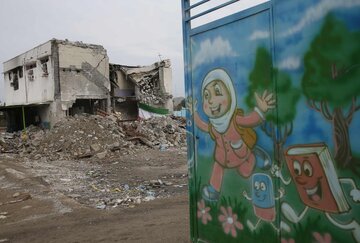
AhlulBayt News Agency (ABNA): The White House unveiled U.S. President Donald Trump’s proposal to end the Gaza war following a prior meeting between Trump and Benjamin Netanyahu. While the plan claims to seek calm in Gaza and an end to the war, critics argue that as time passes, obstruction by the Israeli regime has intensified, and the underlying intentions of the proposal, particularly alongside escalating assaults in the West Bank, have become more apparent.
In an interview with ABNA, Palestinian writer and analyst Saleh Abu Aza described Trump’s peace initiative as a plan introduced to rescue the Israeli regime.
“This plan is designed to manage the conflict in Gaza,” Abu Aza said, “and is based on the assumption that what Israel failed to achieve through military operations and genocide can instead be secured through this so-called peace plan.”
He added that the proposal seeks to provide maximum security and support for Israel while offering Palestinians minimal gains. Nevertheless, he said, Gaza accepted the plan on the basis of ending the war, withdrawal of occupying forces, lifting the blockade, initiating reconstruction, forming a Palestinian committee to administer Gaza, and recognizing weapons as an internal Palestinian matter. “However, to this day, Israel has not adhered to its provisions and has focused instead on implementing what the resistance rejected from the outset,” he stated.
Abu Aza explained that when the plan was announced last October, the resistance agreed in principle but expressed reservations about certain clauses, viewing them as internal Palestinian issues, particularly the question of who would govern Gaza.
“The resistance informed mediators that governance must remain exclusively in Palestinian hands,” he said, adding that Hamas was prepared to hand over control of the Gaza Strip on condition that a national Palestinian administration or committee assume authority. However, the plan stipulated that this committee would be subordinate to a Trump-led peace council, effectively placing Gaza under direct U.S. oversight.
He continued that the second major point of contention concerned weapons. The resistance refused to surrender its arms, telling mediators that these weapons are intended to defend the Palestinian people against the Israeli enemy and that any discussion regarding them must remain confined to Palestinians. The plan, however, sought their complete disarmament, a demand rejected by both Hamas and Islamic Jihad.
Abu Aza asserted that the Israeli regime is “a terrorist and criminal regime” responsible for crimes, massacres, and genocide against Palestinians in Gaza. “It is absurd for a killer to become a man of peace and absurd for a sponsor of terrorism to be portrayed as a peace hero,” he said.
According to the analyst, Israel views Trump’s peace plan primarily as a mechanism to dismantle the resistance and disarm Gaza, which explains its acceptance of the proposal.
He argued that Israel’s war, which lasted more than two years, failed to make significant progress in eliminating the resistance’s weapons. “Now it believes that this U.S.-backed plan could achieve a substantial part of its objective, namely, the disarmament of Gaza,” he said.
Abu Aza further claimed that Netanyahu is obstructing progress on governance arrangements for Gaza, a ceasefire, humanitarian aid deliveries, and reconstruction until success is achieved in disarmament, a condition that, he said, both the resistance and the Palestinian people reject.
Addressing recent Israeli actions in the West Bank, Abu Aza stated that Israel believes all Palestinian land belongs to it and that the time will come to expel all Palestinians from the entirety of the territory and allow Israelis to take control. He said Israeli crimes continue across Palestinian arenas, including Jerusalem, the West Bank, Gaza, territories inside Israel, and prisons.
He concluded that Israel’s actions in the West Bank constitute an attempt to resolve the conflict through gradual and final annexation of the territory, a move he said contradicts international law recognizing the West Bank as land designated for the establishment of a Palestinian state. Nonetheless, he argued, Israel disregards such laws, viewing itself as above them and above all agreements.
**************
End/ 345