

AhlulBayt News Agency: One of Iran’s new and powerful missiles, regarded as an effective component of the country’s offensive doctrine, has been deployed for the first time in the Islamic Revolutionary Guard Corps’ (IRGC) underground missile cities, elevating the combat capability of Iran’s armed forces to an unprecedented level.
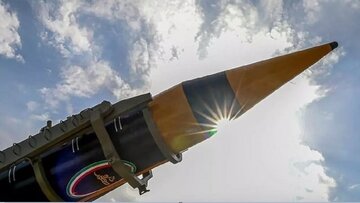
during the unveiling of a new missile city belonging to the IRGC Aerospace Force, one of Iran’s most advanced ballistic missiles—the Khorramshahr-4—was seen among the operational equipment deployed at the facility.
Khorramshahr-4: One missile, multiple messages
The Khorramshahr-4 ballistic missile, regarded as one of the main pillars of Iran’s strategic missile capability, has now entered a stage of operational maturity in which its presence in underground missile cities carries significance beyond a mere technical introduction. The unveiling of this missile city—at a time when overt and covert threats against Iran’s national security are on the rise—demonstrates that Khorramshahr-4 is an active component of the Islamic Republic of Iran’s defensive–offensive posture. This posture is built on the principle of “active deterrence” and a decisive response to any act of aggression.
What features Kheibar has?
The Khorramshahr-4 missile, also known as “Kheibar,” is considered one of the Islamic Republic of Iran’s most advanced long-range missiles, with an announced operational range of about 2,000 kilometers. Unveiled on 25 May 2023, the missile is approximately 13 meters long, 1.5 meters in diameter, and weighs around 30 tons. It is equipped with a heavy 1,500-kilogram warhead—nearly 4 meters in length—making it one of the largest warheads produced in Iran’s missile industry, with the capability to carry more than one ton of explosives.
Hypersonic speed and reduced enemy reaction time
The missile’s speed reaches Mach 16 outside the atmosphere and about Mach 8 within the atmosphere. Such velocity shortens the missile’s flight time from launch to impact to roughly 10 to 12 minutes—a very limited window that effectively deprives many missile defense systems of the opportunity to mount an effective response.
Three flight phases of Khorramshahr-4: From ascent to precision impact
The Khorramshahr-4 missile features three main flight phases. In the first phase, after launch from a mobile platform, the missile sets its altitude, initial speed, and overall flight trajectory.
In the second, or midcourse phase, the warhead separates from the missile body and enters a ballistic path. The engines embedded in the warhead are responsible for correcting disturbances caused by the separation and fine-tuning the flight path. This stage is considered the most critical part of the missile’s guidance, as it minimizes potential errors over the long flight distance.
In the third phase, the warhead prepares to re-enter the Earth’s dense atmosphere. At this stage, the missile’s speed decreases from Mach 16 to about Mach 8, which is still regarded as extremely high for interception by air-defense systems. To maintain trajectory stability during this phase, auxiliary engines are activated, and the warhead stabilizes its path by creating a rotational, drill-like motion, ensuring there is no deviation from the intended point of impact.
Maneuverable warhead with a guidance system based on tactical thrusters
The warhead of the Khorramshahr-4 missile is considered one of the most advanced maneuverable reentry vehicles (MaRV) in Iran’s missile arsenal. According to published technical information, the warhead is equipped with a set of eight auxiliary thrusters: four are responsible for attitude control, stability, and initiating rotational motion of the warhead, while the other four are used for lateral course correction and improving impact accuracy.
This advanced control architecture gives the Khorramshahr-4 warhead high maneuverability and notable precision during the terminal phase of flight. Military experts believe that, in addition to enhancing accuracy, the use of this control system significantly increases the likelihood of the warhead penetrating enemy air-defense systems, playing an important role in boosting the missile’s overall operational capability.
Midcourse guidance; a key factor in improved accuracy and resistance to electronic warfare
Another major feature of the Khorramshahr-4 is that its primary guidance is carried out during the midcourse phase of flight. As a result, once the warhead re-enters the atmosphere, the electronic guidance systems are switched off and the missile effectively transitions into a fully mechanical system.
This characteristic minimizes the impact of enemy electronic warfare, significantly enhancing the missile’s survivability and penetration capability.
High accuracy and heavy destructive power
According to officials from Iran’s defense industries, the Khorramshahr-4 missile has an estimated impact accuracy of about 30 meters at a range of 2,000 kilometers. This level of precision, combined with the missile’s heavy warhead, gives it considerable destructive power.
A clear message to regional and extra-regional adversaries
The operational unveiling of the Khorramshahr-4 missile at one of the IRGC’s new missile cities comes at a time when West Asia is facing rising security tensions and overt threats against Iran. Displaying this missile in the IRGC’s missile city sends a clear message to both regional and extra-regional actors: Iran’s missile capability has not only been maintained, but through modern technologies, its accuracy, speed, and penetration power have been continuously enhanced.
Moreover, the shift in the armed forces’ doctrine toward offensive capabilities indicates that Khorramshahr-4, along with Iran’s other ballistic missiles, plays a key role in active deterrence strategies and in responding to any potential threats. Any miscalculation regarding Iran’s defensive capabilities could lead to costly and irreversible consequences.
/129


Your Comment