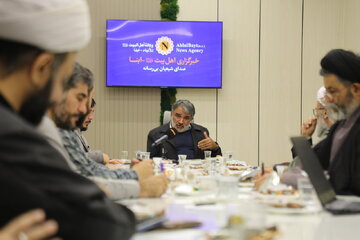
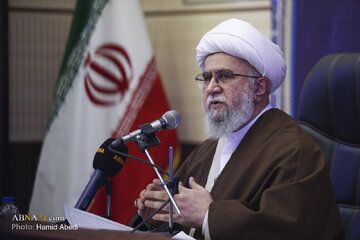
AhlulBayt News Agency (ABNA): A group of members and officials from student clerical associations from Indonesia, Thailand, and Malaysia met with Ayatollah Reza Ramazani, Secretary-General of the AhlulBayt (a.s.) World Assembly (ABWA), at the Assembly’s conference hall in Qom, where they presented their views and reports on activities across Southeast Asia.
Ayatollah Ramazani stated that the meeting marks the beginning of a broader process, noting that specialized sessions should later be held separately for each country to examine issues, capacities, and challenges in a more precise and structured manner.
He emphasized that for Thailand, Indonesia, and Malaysia, a “comprehensive religious cultural document” should be developed based on local capacities and cultural requirements, stressing that each country has distinct social and cultural characteristics.
He added that during a 2006 visit to Indonesia, he documented approximately 150 pages of observations, memories, and discussions from various meetings, which remain unpublished. At the time, he established communication with groups such as Nahdlatul Ulama and Muhammadiyah, while Shiite organizations such as ABI and IJABI had not yet reached their current level of organization and expansion.
Ayatollah Ramazani described cooperation between ABWA’s International Affairs Department and its Scientific and Cultural Affairs Department as essential to advancing these initiatives. He warned that some currents, through improper actions, raise the issue of “Shiite expansion” in a way that fuels division and tension, stressing that the goal is not divisive sectarian expansion but the accurate, scholarly, and precise introduction of the AhlulBayt (a.s.) school of thought. Misrepresenting Shiism, he said, can create thousands of social divisions and constitutes a threat rather than an opportunity.
Referring to a narration from Imam Sadiq (a.s.), he said Shiites are described as possessing eight key characteristics.
Three relate to knowledge and rational understanding:
being rational and thoughtful;
being perceptive and insightful;
and possessing a deep religious understanding.
Five relate to conduct and behavior:
forbearance and restraint from slander;
patience and resilience;
loyalty;
tolerance and constructive engagement;
and truthfulness and honesty.
He stressed that introducing the AhlulBayt (a.s.) cannot rely solely on speech, narration, or historical discourse, as people evaluate followers through behavior, lifestyle, ethics, and social conduct. Proper ethical conduct, he said, determines influence and effectiveness.
Ayatollah Ramazani also warned that promoting Shiism while ignoring the role of the Islamic Republic of Iran and the resistance axis is a dangerous approach, stressing that the AhlulBayt (a.s.) cannot be introduced without acknowledging their struggle for justice and resistance against oppression. He referenced Imam Ali (a.s.), who advised being “an enemy of the oppressor and a supporter of the oppressed.”
Addressing recent developments and what he described as hostile rhetoric by global powers against Iran’s people and leadership, he said the Islamic Ummah is capable of generating political, military, cultural, and economic power, and that the expansion of this civilizational sphere limits the influence of colonial forces. Faith in God and rejection of tyranny, he added, must be understood together.
He concluded that insulting sacred values, particularly the Supreme Leader, constitutes a red line for Muslims and freedom-seekers worldwide, stressing that historical betrayals will not be allowed to be repeated.
**************
End/ 345