

AhlulBayt News Agency: Senior Iranian cleric Ayatollah Abdullah Javadi Amoli has strongly condemned acts of arson, violence, and criminal behavior, stressing that no legitimate objective can ever be achieved through falsehood, lawlessness, or moral corruption.
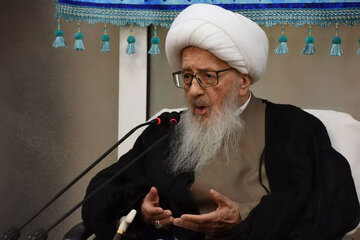
Ayatollah Javadi Amoli made the remarks during his advanced jurisprudence lecture on January 20, emphasizing that reaching a just end through illegitimate means is fundamentally impossible.
“There is no way that anyone can reach their destination through falsehood,” he said, adding that lies, wrongdoing, and deviation are not paths at all, but dead ends. “With arson, burning, crime, and throwing a country into disorder, nothing can be achieved. No one reaches their goal through such actions.”
The senior cleric referred to a well-known narration from Imam Hussein (peace be upon him), who said: ‘Whoever seeks to achieve a goal through disobedience to God will be farther from what he hopes for and closer to what he fears.’ Ayatollah Javadi Amoli described this principle as a decisive moral and rational rule, rejecting the notion promoted by some wrongdoers that “the end justifies the means.”
“This logic—that one can reach a noble goal through immoral tools such as arson, destruction, and crime—is entirely false and must never be followed,” he stressed.
Ayatollah Javadi Amoli underlined that corrupt means can never produce righteous outcomes, reiterating that falsehood is not merely an incorrect route but a complete deviation from the path of truth. “Disorder, violence, and criminal acts cannot lead a society to reform or salvation. This is a universal principle articulated clearly by Imam Hussein (peace be upon him),” he said.
He further noted that this principle is not limited to religious rulings or purely jurisprudential matters. “It is a fundamental law governing judicial, legal, social, and personal affairs. It is impossible for anyone to reach a true objective through sin or illegitimate methods,” he added.
In another part of his remarks, Ayatollah Javadi Amoli emphasized the necessity of confronting corruption and corrupt individuals in order to safeguard society. Citing the renowned Shiite jurist Akhund Khorasani, he said that when corruption threatens the public order, it becomes the duty of the government to expose and hold corrupt actors accountable to protect the community.
His remarks come amid broader discussions within Iranian religious and intellectual circles on social order, moral responsibility, and the role of ethical conduct in achieving justice and stability in society.
......................
End/ 257



Your Comment