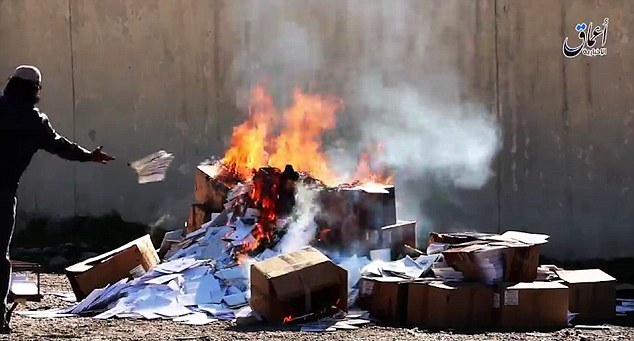
ISIS has released a video purporting to show members of its police burning hundreds of Christian books which it considers blasphemous towards Allah.
The footage shows a militant tossing pamphlets and manuscripts bearing crucifixes on the front cover onto a bonfire in the terror group's stronghold of Mosul in northern Iraq.
It is the latest incident in which the terrorists have sought to purge society of anything that doesn't conform to their violent interpretation of Islam.
The video was posted online yesterday by its news agency Amaq with the title: 'Diwan of education destroys Christian instruction books in Mosul.'
The Diwan Al-Hisba – or Chamber of Morality Police – was set up by ISIS soon after seizing swathes of territory in its lightning offensive through Iraq and Syria in June 2014.
It is responsible for enforcing the group's warped version of sharia law and imposes penalties ranging from flogging for minor misdemeanors like smoking to amputations and beheadings.
In February last year, it destroyed around 10,000 books and more than 700 rare manuscripts when it blew up the main library in Mosul.
They are thought to have included its collection of Iraqi newspapers dating to the early 20th century, maps and books from the Ottoman Empire and book collections contributed by around 100 of Mosul's establishment families.
Speaking at the time, one local said a bearded militant told him: 'These books promote infidelity and call for disobeying Allah. So they will be burned.'
The group has also destroyed many archaeological relics such as Palmyra in Syria, deeming them pagan, and even Islamic sites are considered idolatrous.
A University of Mosul history professor, who spoke on condition he not be named because of his fear of the ISIS group, said the extremists started wrecking the collections of other public libraries in December 2014.
He reported particularly heavy damage to the archives of a Muslim library, the library of the 265-year-old Latin Church and Monastery of the Dominican Fathers and the Mosul Museum Library with works dating back to 5000 BC.


/257