
(AhlulBayt News Agency) - Terrorists of the Takfiri ISIS group have demolished two more treasured monuments in the ancient Syrian city of Palmyra a month after recapturing it from government forces, the antiquities chief said Friday.
“Local sources told us that 10 days ago ISIS destroyed the Tetrapylon,” a 16 columned structure that marked one end of the ancient city’s colonnade, Maamoun Abdulkarim told AFP using an Arabic acronym for ISIS.
“Yesterday (Thursday), we received satellite photographs from our colleagues at Boston University showing damage to the facade of the Roman amphitheater,” he added.
Before being forced out of Palmyra in a Russian-backed offensive in March last year, ISIS carried out a campaign of destruction at the city’s UNESCO-listed world heritage site, razing treasured temples and tower tombs.
The Tetrapylon, built during the rule of the Roman Emperor Diocletian in the 3rd Century AD, consisted of four sets of four pillars each supporting massive stone cornices.
It was a type of monument often constructed by the Romans to mark key crossroads but that at Palmyra was regarded as one of the greatest.
The monument had suffered considerable damage over the centuries and only one of the 16 pillars was still standing in its original Egyptian pink granite. The rest were cement replicas erected by the antiquities department in 1963.
The Roman amphitheater dates to the 1st Century AD. During its first occupation of the city between May 2015 and March last year, ISIS notoriously used it as a venue of public executions and one of its walls was riddled with bullet holes.
“From the first day, I was bracing myself for a terrible outcome,” Abdulkarim said.
“We had already witnessed the terror of the first occupation and frankly I had never thought that the city would be occupied for a second time.
“The battle for Palmyra is cultural not political. I have never understood how the international community and the main players in the Syria conflict could accept the fall of Palmyra.”
/298
20 January 2017 - 11:30
News ID: 806096
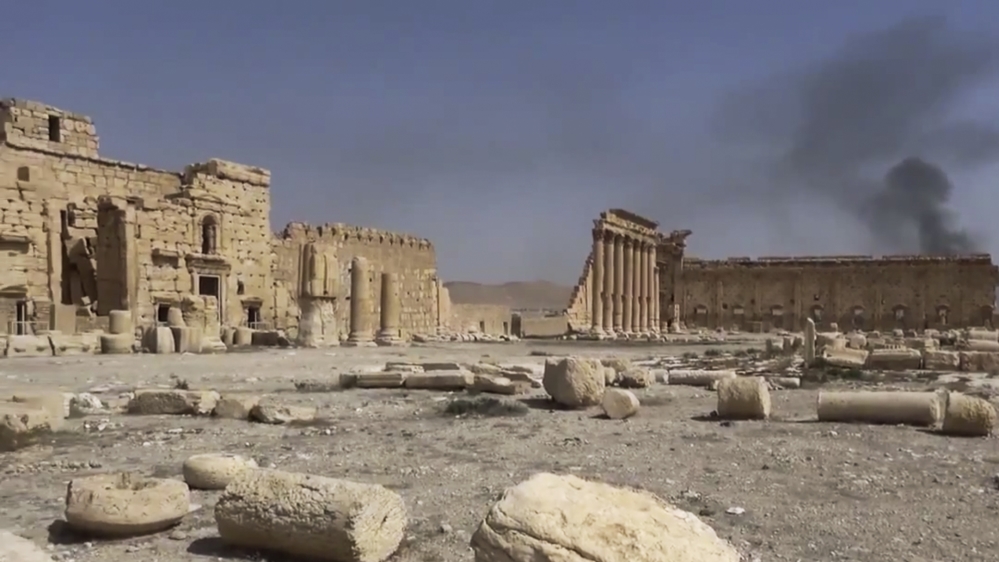
Terrorists of the Takfiri ISIS group have demolished two more treasured monuments in the ancient Syrian city of Palmyra a month after recapturing it from government forces, the antiquities chief said Friday.



