
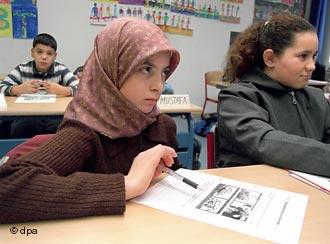
"They (textbooks) impose on little children ideas that foreigners are bad and are involved in theft and violence,” Burhan Kesici, the Secretary-General of the Islamic Council of Germany, told Anadolu Agency on Friday, March 27.
"This lingers in their minds and becomes part of daily conversations and discussions at school," he added.
Conducted under the Federal Government Commissioner for Migration, Refugees and Integration and commissioned to the Georg Eckert Institute, the German government research project examined 65 textbooks in five states on the subjects of politics, social sciences and geography.
Unveiled earlier in March, the project concluded that immigration and diversity were presented as problems that should be combatted to attain homogenous societies.
Referring to the government’s research, Kesici, who also gives Islamic lessons in capital Berlin, warned that textbooks typically contained prejudice against migrants and in some cases even denigrate them.
Some books even contain examples of stealing by using characters with traditional Muslim names like Ahmad.
Referring to widely-spread misconceptions about the Muslim community, he added that there was already a general lack of knowledge about foreigners and Muslims in the country, which was compounded by negative comments and judgments in textbooks.
"If this was done against other minorities, all hell would have broken loose," he said.
"But when it's specifically about foreigners coming from Muslim countries, when it's (about examples using Muslim names such as) Ahmad and Aisha, then nobody reacts," he added.
Criticism
The textbooks were also criticized by Left party's Berlin State Assembly member Hakan Taş and The Greens party Federal Assembly member Özcan Mutlu.
Taş called on German authorities to work towards teaching the last 50 years of migration in German history.
"For example, Ahmad will not play with Jurgen in the playground because Jurgen will be "prejudiced on account of the textbooks," he said.
“We need to say stop to racism by starting the struggle at schools to prevent prejudice and xenophobia from taking root,” he added.
Mutlu shared a similar opinion.
"Germany legally acknowledged in 2005 that it is an immigration country. However, when you look at its educational institutions, textbooks and curricula, you'll see that migrants are somewhat represented as bogeymen," he said.
Last December, a new study on German perceptions of immigrants to the European country showed a widespread view that Muslims are not German patriots, blowing away decades of integration of the four-million Muslim community.
According to Der Spiegel, 27 percent of respondents think that Muslims are more "aggressive than themselves", while 30 percent believe that Muslims show less importance to education
A fifth of respondents expressed a negative opinion about Muslims making demands in Germany, with about 20 percent seeing it as a sign of disrespect and 17 percent seeing it as a sign of ingratitude.
Interviewed people expressed reservations against Islam, showing large gaps in information about the faith and widespread misconceptions.
Moreover, 70 percent of respondents believed that the number of Muslims living in Germany was higher than it actually is.
Almost a quarter even believe that more than 21 percent of the population in Germany is Muslim, while in reality there is around five percent.
/275, 149



