
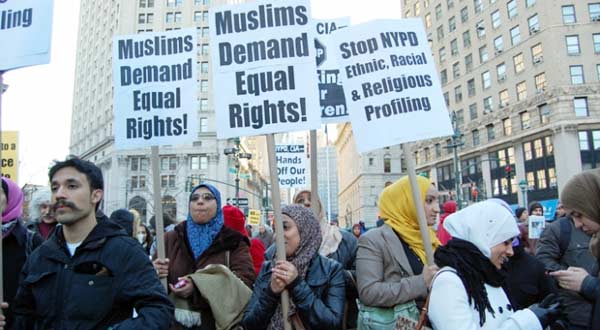
Released on Monday by US president Barack Obama, new guidelines to curb racial profiling have been criticized by American Muslims for retaining "Muslim" carve-outs on profiling by security screening in airports and border checkpoints.
“The Council on American-Islamic Relations (CAIR) is dismayed that at a time when our nation is struggling to come to terms with a series of high-profile police killings of unarmed African-Americans, the DOJ would release revised profiling guidelines that include loopholes for targeting US Muslims and Hispanics,” the group said in a statement obtained by OnIslam.net.
"The addition of religion, national origin and other characteristics to the guidance is a sign of progress. However, these additions remain only a symbolic gesture if, according to reports, the DOJ keeps carve-outs for the Department of Homeland Security (DHS), Transportation Security Administration (TSA), and Customs and Border Enforcement (CBP) to discriminate at airports and the US border, and allows the FBI to 'map' minority communities to place informants.”
Obama released the new guidelines on Monday which restrict the ability of federal law enforcement agencies to profile on the basis of religion, national origin and other characteristics.
According to the Justice Department, the new protocols could be a model for local departments as the nation tackles questions about the role race plays in policing.
The policy, which replaces decade-old guidelines established under the Bush administration, also will require federal agencies to provide training and to collect data on complaints.
The new guidelines do not apply to local or state law enforcement but does apply to state and local officers in federal law enforcement taskforces.
While some civil rights groups welcomed the guidelines, Muslims warned that they will continue to allow security agencies profiling of Muslims.
"Under these guidelines the DOJ will still authorize the FBI's racial mapping program to continue registering minority neighborhoods from across the nation for possible surveillance and insertion of informants - spanning African-Americans in Atlanta, Ga., to Asian-Americans in the San Francisco Bay area, to Arab and Muslim Americans in Dearborn, Michigan,” CAIR said.
No Progress
American rights groups have condemned the loose drafting of the new guidelines for allowing exceptions that permits anti-Muslim profiling.
"It's so loosely drafted that its exceptions risk swallowing any rule and permit some of the worst law enforcement policies and practices that have victimized and alienated American Muslim and other minority communities," Laura Murphy, director of the ACLU's Washington Legislative Office, said in a statement.
"This guidance is not an adequate response to the crisis of racial profiling in America."
CAIR has also warned that the curbs will not cut Muslim complaints of be targeted in airports.
"These guidelines will do nothing to stem the complainants CAIR receives from American Muslims that CBP profiles them based on their religion at the northern border and when returning home from travel abroad by asking about First Amendment protected activities,” the group said.
"The promise of racial and religious equality enshrined in the US Constitution is left unfulfilled if we as a nation are not brave enough to see the inequality that currently exists and are too weak to hold our systems of justice accountable when it fails to preserve the rights of any minority community.
"With the release of this new guidance, the rights of American Muslims at the airport, border and in their communities and houses of worship remain at risk.
“CAIR expected more progress from the DOJ and White House and urges all Americans to contact their elected officials to urge passage of the End Racial Profiling Act (ERPA), an act that will truly eliminate all forms of profiling without exceptions, carve-outs or loopholes," CAIR added.
In 2003, the DOJ made a partial attempt to put a stop to racial profiling by issuing guidelines that banned federal law enforcement officials from engaging in profiling but permitted the use of religion and national origin.
The 2003 guidance was also ineffective to stop discrimination because it includes open-ended loopholes that allow federal law enforcement agencies to profile at U.S. borders and for reasons of national security. The new guidance retains some aspects of these previous loopholes.
Recently CAIR responded to Attorney General Eric Holder's announced resignation by asking that he "issue guidelines on racial profiling that protect the rights of all Americans without any exceptions" as he makes his exit from office.
CAIR is America's largest Muslim civil liberties and advocacy organization. Its mission is to enhance the understanding of Islam, encourage dialogue, protect civil liberties, empower American Muslims, and build coalitions that promote justice and mutual understanding.
/257



