
(Ahlul Bayt News Agency) - Saeedabadi told reporters on Wednesday that with addition of the two works the number of Iranian works entering the UNESCO list has reached seven.He said the works were added in the 11th meeting of the International Advisory Committee for the Memory of the World Program, held in South Korea on June 18.He added that in the meeting, 54 new works from 40 countries found their way to the Memory of the World Register list. “The Reserve of the Khwarizmshah Dynasty” (Zakhire-ye Kharazmshahi) was one of the documentary heritage submitted by Iran and recommended for inclusion in the Memory of the World Register in 2013. The other work submitted by Iran to the UNESCO was ˈA Collection of Selected Maps of Iran in the Qajar Era (1193 - 1344 Lunar Calendar / 1779-1926 Gregorian Calendar)ˈ. Thus far a total of 299 works, 7 of them Iranian, have been included in the list.Documents detailing “Maps from the Qajar Period” and “The Reserve of the Khwarizmshah Dynasty” (Zakhire-ye Kharazmshahi) were sent to UNESCO’s International Advisory Committee last week, Fariba Farzam, a member of the Iranian National Committee for Memory of the World said.Translation of the documents was completed under the auspices of the National Commission for UNESCO, she added. Saeedabadi said Iran ranks third in Asia in terms of registered works and is among top 10 countries in the world. Zakhīra-yi Khārazmshāhī is the first and most important medical treatise, prepared in the Persian language. This work is authored by ˈEsmaeil Jorjaniˈ. For centuries the Zakhīra has been used as an authentic source in medical education. It has served as the basis of many books on Medicine. The treatise, which was translated into Arabic by its author, has been of great use in Iran, Central Asia, India and the Ottoman empire. The book has also been translated into Urdu, Turkish and Hebrew-an indication of the bookˈs significance for other nations.The collection of maps is a compilation of handwritten and lithographic maps which show the geographical plateau of Iran as a major part of the historical Silk Road as well as the interface of the North-South corridor. The collection is a significant research document, providing an authentic source for studying the demographic, natural, historical and cultural geography of different West-Asian regions. The maps provide information on boundary lines, impacts of human-instigated and natural disasters on the borders, and geographical place names some of which are now either non-existent or have been renamed.Translation of the documents was completed under the auspices of the Iranian National Commission for UNESCO.The UNESCO’s Memory of the World Register is a list of library collections and archive holdings of world significance. “Maps from the Qajar Period” consists of 500 unique hand-drawn and lithographic geographical maps that are kept at the Center for Documentation and Research Services of the Iranian Ministry of Foreign Affairs. Most of the maps refer to Iran and nearby regions. Some of the maps show the lands, which were split from Iran over the past centuries as result of political events. Some of the maps bear the signatures of officials and political and cultural figures of the time in the margins. “The Reserve of the Khwarizmshah Dynasty” is a Persian reference book on traditional Iranian medicine, which has been authored by Seyyed Ismael Jurjani (c. 1042-1136 CE), mostly known as Hakim Jurjani. Topics from speech therapy to varieties of pesticides are discussed in the book that is kept at the library of the Shahid Motahhari School and Mosque in Tehran. There are several other versions of the book in Iranian libraries, but the version kept at the library of the Shahid Motahhari School and Mosque in Tehran is the most intact one. Five other works have already been registered on UNESCO’s Memory of the World Register list. A collection of Iranian documents dating back to the Safavid era was added to the list in 2009. In addition, the Shahnameh of Baysunqur, one of three ancient copies of Ferdowsi’s epic masterpiece, and the Endowment Deed of Rab-e Rashidi are two other Iranian works, which were registered on the list in 2007. “At-Tafhim” written by Abu Rayhan Biruni (973-1048 CE) and “Khamseh” composed by Nezami Ganjavi (c. 1141-1209 CE) were other Iranian works registered on the list in May 2011.End item/ 149
18 June 2013 - 19:30
News ID: 431463
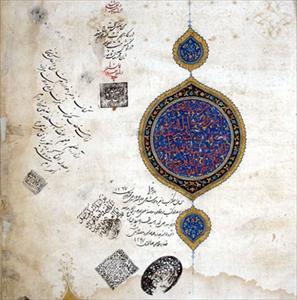
Secretary General of the National UNESCO Commission, Mohammad-Reza Saeedabadi said on Wednesday that two new Iranian literary works were added to the UNESCOˈs Memory of the World Register list.



