

ABNA24 - Nearly three months after Minab school war crime by the US and Israeli regime, the wound is still fresh, never to fade from memory of the Iranians.
In addition to several commemorations, recently a new ceremony was held at the site of the barbarously bombed school in Hormozgan province south of Iran. The aim was clear: To keep memory of the martyred school girls and personnel alive and to recount that bitter, painful day.
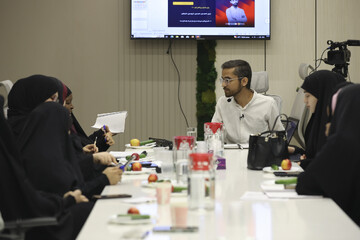
In this relation, the international “1+168” campaign, under the slogan “I Am the Voice of Minab”, was held on Thursday at the Shajareh Tayyebeh school site, with the families of the martyred students, a number of media activists, and foreign journalists in attendance. It was at this school that, during the US and Zionist regime’s attack on February 28, dozens of students and several of their teachers were killed, and the classrooms turned into scenes of blood and rubble.
After the ceremony and press conference ended, the families and attendees made their way to the martyrs’ cemetery for the student victims. There, on Thursday evening, grieving mothers and fathers, brothers and relatives of the martyrs had gathered beside their children’s graves, keeping their loved ones’ memory alive through tears, prayers, and soft recitations of the Quran.
One mourner still wept with longing for her school daughter. Another sat by the grave of his only son. Yet another father had lost both his wife and child in that atrocity. The Minab martyrs’ cemetery told the story of countless sorrows, wounds that remain fresh on the hearts of these families.
Paintings that took blood color
In the ceremony, Zahra Haj Husseini, a teacher who survived the crime, recounted the tense moments of that day.
“After the first explosion, I rushed to the class and then called the parents to come collect their children. Around 11:20 a.m. a massive explosion hit the school. I struggled to open the door of the class and around five seconds later, I heard the second and third explosions, the sound of which was closer and more horrifying. I barely managed to pull myself up, and with my own eyes I saw the second floor of the school collapse onto the first.”
The surviving teacher then posed a critical question: “How could the United States not see the school’s murals? Aren’t they the ones who claim to have the most advanced surveillance technology?” She emphasized: “My responsibility now goes beyond being a teacher at a Minab school. I must be the voice of these children’s suffering for the entire world.”
Meanwhile, a Minab student at the ceremony said: “Those who remain silent are just as guilty as those who committed this atrocity. I will remain a student of the Shajareh Tayyebeh school to be the voice of my martyred brothers and sisters.”
“The ones who destroyed our school are America and Israel. God kept me alive so I could avenge my friends’ blood and bring honor to Iran. We will rise again and rebuild our school,” another student said.
Eyewitnesses and dozens of foreign journalists at the ceremony worked to convey the full scale of this atrocity to the international community and to galvanize world public opinion against it, to show that the massacre of innocent children, wherever it occurs, is an unforgivable crime that will forever stain its perpetrators with shame.
What truly matters is the global public’s humane response and widespread sympathy in the face of such tragedies. In recent years, this empathy and sensitivity have grown more than ever before. And this time, too, the martyrs of the Minab school have moved countless hearts around the world, in the hope that this awakening and global solidarity might prevent such crimes from happening again.
Earlier some human rights organizations and international media outlets retold the Minab school crime story by visiting the site, something aimed at efforts by the US and Israeli regime to blur or change account of this crime.
US, the lead perpetrator
Citing the eyewitness and satellite images that confirm the US attack on the Iranian school with missiles, Washington rises as the top party to blame for this atrocious missile strike.
Ali Niko, secretary of the “1+168” campaign, said in response to recent events in Minab that “what is happening today to innocent children is part of a broader puzzle of organized crimes by the arrogant powers, who deliberately target civilians and children, using these tragedies as tools in the arena of international politics.”
Morteza Karamouzian, head of Iran’s Media Basij (Mobilization), stated that the media activists present at the event are pursuing two major narratives: first, the “document of Iran’s victimhood,” centered on the Shajareh Tayyebeh school attack; and second, the “document of Iran’s strength,” related to control over the Strait of Hormuz.
Babak Khajeh Pasha, a film director and former Iranian representative to the Oscars, sharply criticized the silence of international film festivals and media outlets over the killing of Iranian and Palestinian children. “The media empire,” he said, “boycotts any artists and athletes who speak out in defense of Palestinian and Iranian children.”
He also lashed out at global film festivals, declaring: “Shame on any festival or artist who remains silent about the martyred children of Minab. A major portion of the world’s cinema is in the hands of Zionists, and that is precisely why they cannot bring themselves to speak the truth.”
It is noteworthy that American officials, despite all available evidence and documentation, have still not accepted responsibility for this atrocity. They have repeatedly stated that they are investigating the incident, but to date, they have expressed no regret or remorse over the attack.
Minab school crime, the bloody document of fake Western human rights advocacy
The tragedy of the children of Minab school is so painful that is echoed not only in the narrative of the Iranians but also in the words of the foreign citizens and journalists for the world to see what crime Washington and Tel Aviv committed.
Kenneth Nichols O’Keefe, a former American marine and Persian Gulf War veteran who attended the ceremony in Minab, addressed the world public while standing on the rubles of the school: “Just imagine those same Tomahawk missiles that are built in Tucson, Arizona, raining down on your children. Imagine Iran killing 132 of your sons and daughters. How would that make you feel? Would it still be wrong for you to shout ‘Death to Iran’?” He also pushed back against the intense propaganda machine and accusations leveled at Tehran, asking: “How dare you feed these lies to the world? You tell me what terrorist act has Iran ever committed against you?”
The remarks by this US Navy veteran tore away the veil of indifference shown by large segments of the international community toward this atrocity and exposed just how deeply Western powers’ responses to such events are shaped by double standards. His words served as a bitter reminder: the value placed on children’s lives is not measured equally in the eyes of certain Western governments and media outlets. Reactions are dictated more by political calculations than by basic human principles.
Although some Western officials condemned the crime against the Minab school and called for a full investigation, the scale and intensity of those responses never reached a level that could exert serious or effective pressure on Washington and Tel Aviv. This stands in stark contrast to how the very same governments react to similar incidents elsewhere in the world, particularly in Ukraine, where they swiftly take a stand and unleash a massive wave of political and media condemnation.
These double standards in reactions is unacceptable for the world. When killing of a group of children in a region is raised as a “crime against humanity” while killing of hundreds of Iranian school children is given media blackout or minimum reactions and attention, it is natural that serious questions are raised about the honesty of the human rights advocates, and indeed these paradoxes question the concepts of humanity and justice more than any other time.
/129


Your Comment