

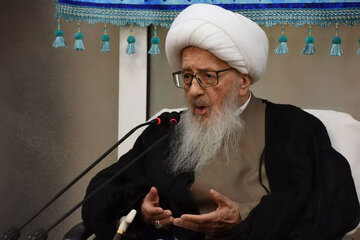
AhlulBayt News Agency: Grand Ayatollah Nasser Makarem Shirazi, a senior Shia source of emulation, has issued a religious ruling addressing the concerns of believers regarding this year's Hajj pilgrimage to Mecca. The ruling comes in response to queries from his followers about the obligation to perform the pilgrimage under prevailing circumstances.
In a statement released through Hawzah News Agency, Ayatollah Makarem Shirazi's office confirmed that the revered cleric had responded to an istifta—a formal request for a religious edict—submitted by a number of his emulators. The faithful had sought guidance on whether they remain religiously obligated to undertake the journey to the Holy House of God given existing concerns.
In his response, the Grand Ayatollah outlined two key scenarios for believers.
First, he stated that individuals who have attained the financial and physical capability to perform the obligatory Hajj this year, but who harbor a rational and well-founded fear—specifically citing concerns over mortal danger, serious insecurity, or similar threats—do not meet the criteria for "Istata'ah Shar'iyyah," or religious capability. Under such conditions, the obligation to perform the Hajj is not established.
Second, for those whose capability to perform the pilgrimage was attained in previous years but who have postponed the journey, Ayatollah Makarem Shirazi ruled that if they now possess a reasonable and rational fear regarding travel, they are permitted to defer the pilgrimage to the following year.
The ruling provides significant religious clarity for Iranian pilgrims and Shia communities worldwide, delineating the boundaries of religious obligation when faced with genuine safety concerns. This guidance is expected to relieve the consciences of believers grappling with the intersection of spiritual duty and personal security.
The Grand Ayatollah's statement reaffirms the jurisprudential principle within Islamic law that the preservation of life constitutes a primary objective, and the performance of religious duties must not place believers in situations of unreasonable peril.
.......................
End/ 257



Your Comment