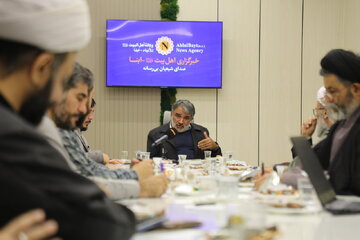
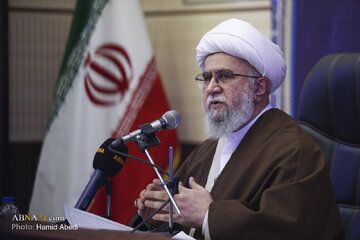
AhlulBayt News Agency (ABNA): The first session of the series “Mahdist Teachings: The Roadmap to the New Islamic Civilization” was held at the auditorium of ABNA News Agency, organized by the Mahdism Association in cooperation with the Imamate Research Institute. The session aimed to examine the civilizational and structural dimensions of the institution of Imamate within Mahdist discourse and its role in the formation of the new Islamic civilization.
A number of seminary and university professors and researchers addressed the gathering.
Without Proper Understanding of Imamate Institution, Mahdist Thought, Movement Toward the New Islamic Civilization Impossible
Hojat al-Islam Mohammadreza Fuadian, a seminary professor and researcher in Mahdism studies, stated during the session that many assume liberalism can determine the course of humanity, whereas American-style human rights have come to dominate the world. As the Supreme Leader has stated, humanity must reach the understanding of its own need and refrain from attaching its heart to anything other than God.
Elaborating on the historical trajectory of Islamic civilization, he said, “All civilizations have striven for their growth and survival, and now all await the Reappearance of Imam Mahdi (a.s.). With the beginning of the Imamate of the Twelve Imams, God revealed the verse of the perfection of religion and the completion of blessing.” He added, “The current of falsehood, through the formation of Saqifah, sought to undermine Islamic civilization, yet God placed the matter upon the shoulders of the people so that they might prove themselves steadfast upon the path of truth.”
He emphasized in conclusion, “Movement toward the new Islamic civilization is not possible without a proper understanding of the institution of Imamate and Mahdist thought, for the Mahdist government is the complete civilizational manifestation of the institution of Imamate in human history.”
Mahdist Civilization Is a Civilization of Rationality; Rationality Is Inseparable from Civilization
At the outset of his remarks, Hojat al-Islam Ali Saeili, a seminary and university professor, referred to the conceptual complexity and ambiguity of civilization, saying, “Discussion in this field is extremely broad, and to encompass it within a short time is difficult. Civilization is among those concepts that are highly ambiguous and bear great similarity to the concept of culture.”
Referring to the government of Imam Mahdi (a.s.), he stated, “The state of Lady’s Proof will be a state of rationality; its آثار will be entirely rational and will manifest objectively.”
He added, “Under such conditions, Islamic civilization will advance and bring numerous آثار and blessings to humanity.”
In concluding his remarks, he noted, “If we speak to the youth of the world through the door of rationality, as the Supreme Leader pursues this path, and place them in the correct direction of history, they will certainly become acquainted with the truth and may even incline toward Islam.”
Explaining the ‘Institution of Imamate’ in the Context of History: From the Objectification of Imamate to the Civilizational Horizon of the Mahdist Government
Hojat al-Islam Mohammad Farmehni Farahani, head of the Department of Imamate History Studies at the Imamate Research Institute, began by presenting a definition of the history of Imamate. He stated, “The history of Imamate, meaning the history of the institution of Imamate, signifies that all the attributes you recognize in Imamate must be studied in their social extension and tangible manifestation within the daily life of human beings during the time of the Imam’s presence.”
Criticizing the prevalent view of history as primarily political and power-centered, he remarked, “The history of Imamate seeks to highlight the role of influential elements within the social body, a role that is usually not visible in official histories.”
In this regard, he referred to the conduct of Imam Ali (a.s.) and said, “At the very time when he appears outwardly silent and people say that Ali ibn Abi Talib is in the field, digging wells and planting palm trees, at that very time he exercises Imamate and brings about transformations in social relations that even a ruling political caliph might not accomplish.”
Farmahni emphasized, “The true life of humanity begins from the era of the Reappearance; a path that is the Straight Path and leads not merely individuals but humanity itself to the goal of creation.”
**************
End/ 345