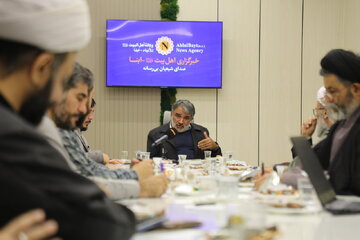
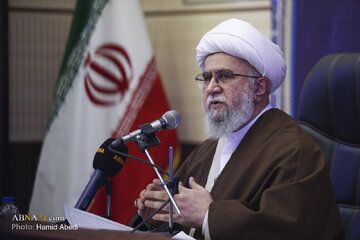
AhlulBayt News Agency (ABNA): In a speech marking the occasions of Sha‘baniyah and the anniversary of the victory of the Islamic Revolution, the Secretary General of the AhlulBayt (a.s.) World Assembly addressed key issues related to Mahdism, the challenges of the contemporary world, and the pillars of the Islamic system, as well as the achievements of Iran’s Islamic Revolution.
Ayatollah Reza Ramazani, elaborating on the position of Mahdism within the broader framework of religion and the philosophy of history, stressed that Mahdism is not a marginal belief but rather a global response to the crisis of meaning, injustice, moral collapse, and profound human deadlocks in the modern world.
Referring to the remarkable scientific advances of the contemporary era, he said these developments, on the one hand, have created opportunities to enhance human comfort, but on the other, due to their control by oppressive rulers and their detachment from faith, spirituality, and human ideals, have turned into a serious threat to humanity.
Pointing to two bitter experiences of today’s world, Ramazani stated that the first is the crisis of meaning, injustice, moral breakdown, political and social deadlocks, racial discrimination, and the growing threat to global security and justice, to the extent that international justice and security are now gravely endangered.
He described the second experience as humanity’s deep distrust of the grand promises of global powers, saying, “Powers that claim to save humanity and establish peace consider themselves absolute rulers of the world, and in practice have sought to enslave nations, spreading poverty and discrimination instead of order and security.”
He emphasized that in the face of these impasses, the believers’ outlook toward the Promised Savior offers a great and mobilizing hope for the salvation of humanity.
Ramazani pointed to two contrasting perspectives on humanity’s future, saying one is the Hollywood narrative that portrays the end times as an era of war, fear, and human collapse, reflected in numerous cinematic works. In contrast, there is a hopeful vision that sees the future of humanity as meaningful, rational, and accompanied by scientific and moral flourishing.
He added that this hopeful outlook is rooted not only in Islamic traditions but also in the authentic beliefs of other religions, including the conviction among Christian scholars in the return of Prophet Jesus Christ (a.s.) to establish peace and justice.
Stressing that Mahdism in the Shiite tradition is an integral part of the broader framework of religion, the Secretary General said that Imam Mahdi (a.s.) is the “Promised One” and the continuation of the line of Imamate, adding that occultation does not mean the absence of the Imam, but rather the absence of his manifest Reappearance.
From the perspective of the philosophy of history, he said, Mahdism shows that history does not follow a blind and purposeless path, but rather moves toward a clear horizon and ultimate goal: the realization of global justice and security.
Explaining the concept of Awaiting, Ramazani said a true expectant is not despairing, passive, or naive, but an active and rational agent striving to realize global justice. Mahdism, he added, responds to humanity’s innate need for justice and reinforces hope in the face of nihilism.
Referring to the profit-centered rationality dominating today’s world, he stated that Mahdism places reason alongside faith and knowledge alongside spirituality, and that this synthesis lays the groundwork for genuine social growth. With the advent of Imam Mahdi (a.s.), both sciences will flourish, and human intellect will reach perfection.
Pointing to the confrontation between two discourses in the contemporary world, Ramazani said that today the discourse of resistance stands against the discourse of submission to humiliation. He noted that enemies have sought to prevent the revival of this discourse through division, but the Islamic Revolution has continued its path with strength and determination.
Referring to the fight against terrorism, he added that the only discourse that truly stood against terrorism was that of the Islamic Revolution. “Figures such as Martyr Hajj Qassem Soleimani, who were on the front lines of the struggle against ISIS, were assassinated by those who claim to defend human rights.”
**************
End/ 345