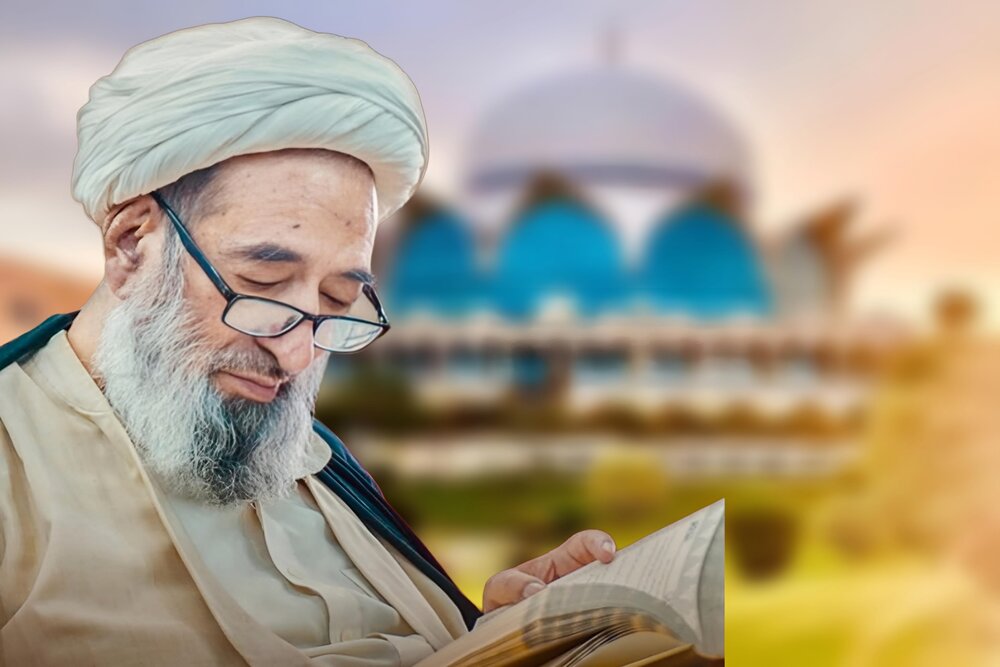
AhlulBayt News Agency (ABNA): Ayatollah Mohsen Ali Najafi was a Shia commentator and scholar from Indian Subcontinent in Pakistan. He founded the Jamiat Ahl al-Bayt, Jamiat al-Kawthar, and the Aswa educational system in Pakistan. He has written works in Arabic and Urdu, including Al-Kawthar fi Tafsir al-Quran. Mohsin Ali Najafi also represented Ayatollah Sistani in Pakistan and chaired the Supreme Council of the Majma’ al-Ahl al-Bayt (AS) in Pakistan.
After completing his primary education at Jamiat al-Muntazar, Lahore, under professors such as Syed Safdar Hussain Najafi and Hussain Bakhsh Jara, Mohsen Ali traveled to Najaf Seminary in 1966 to pursue higher education, benefiting from Syed Abul Qasim Khoei and Syed Muhammad Baqir Sadr. Najafi returned to Pakistan from Iraq in 1976 and settled in Islamabad.
Biography
Mohsen Ali Najafi was born in 1943, 60 km from Skardu, Baltistan, Pakistan, in the Kahramang district, in a village called Mantokheh. His father, Hussain Jan, was a scholar of the area. Mohsin Najafi began his primary education with his father Hussain Jan. His father died at the age of 14, and after his death, he continued his education with a scholar of his village, Syed Ahmad Mousavi. In 1963, Mohsin Najafi began studying at the Mashare'ul Uloom School in Sindh, and within a year, he also learned Urdu in addition to his studies. After that, he traveled to Punjab and became a student of Maulana Muhammad Hussain at Darul Uloom Jafariya Khushab. Najafi went to Jamiat-ul-Muntazhar, Lahore, to continue his studies, and studied under professors such as Hussain Bakhsh Jara and Safdar Hussain Najafi. In 1967, he went to the Najaf Seminary for higher education and studied religious sciences with Ayatollah Khoei, Martyr Baqir al-Sadr, and other professors of that seminary.
After the Baath government came to power in Iraq and put pressure on religious centers, he left Iraq for Pakistan and settled in Islamabad, where he founded a school called the Ahl al-Bayt School.
Mohsen Ali Najafi also served as Ayatollah Sistani's representative in Pakistan and as the chairman of the Supreme Council of the Ahlul Bayt (AS) Assembly in Pakistan.
Death
Mohsen Najafi died in Pakistan on 19 January 1402 and was buried on 10 January at the Al-Kawthar University in Islamabad. On the occasion of Mohsen Ali Najafi's passing, some religious authorities, especially Ayatollah Khamenei Ayatollah Sistani and Ayatollah Bashir Najafi, offered condolences.
Books
Mohsen Ali Najafi wrote and published numerous books in Arabic and Urdu, some of which are as follows:
• Al-Kawthar fi al-Tafsir al-Quran: A fluent and simple commentary in Urdu, consisting of 10 volumes. In this commentary, he translates the beginning of the verses, then explains the words, and finally discusses the status of the revelation and ethical and doctrinal issues.
• Balagh-ul-Quran: Translation and commentary on the Quran in Urdu
• Al-Nahj Al-Savi in the meaning of Al-Moli Waloli (in Arabic)
• Darasat al-Idalogiyah al-Sortah (in Arabic)
• Islamic Concept of Hardship (in Urdu)
• Philosophy of Prayer (in Urdu)
• A Guide to Principles for Regime Change and Regime Revolution (in Urdu)
• Takhis al-Mutiq for Allama Al-Muzaffar (in Arabic)
• Takkhis al-Ma'ani for Taftazan (in Arabic)
• Compilation and preservation of the Quran (in Arabic)
• Islamic Philosophy and Marxism (in Urdu)
Translations
Ayatollah Najafi has translated books into Urdu:
• Islamic Economics
• A scholarly look at Hussein's revolution
• Friendship from the perspective of the innocent.
Scientific and cultural services
Mohsen Ali Najafi's scientific and cultural services are as follows:
• Ahlul Bayt Schools: A collection of schools across Pakistan, run by Mohsin Ali Najafi, numbering 27. Of these, 18 are for men and 9 for women, the most important being the Ahlul Bayt Society and the Al-Kawthar University, located in the capital of Pakistan. In addition to
teaching Lamta'in, Rasa'il, Makasib, Kifayateen, and extracurricular courses, the University also has academic facilities.
• The Aswa Educational System of Pakistan: This institution is a branch of the Jaber Bin Hayyan Trust, which was run under the supervision of Mohsin Najafi and has been operating in various parts of Pakistan since 1994. In this system, 12 colleges, 4 arts colleges, 2 paramedical colleges, 1 IGSC college and 58 evening schools (from primary to diploma) are active. The most important of them are Aswa College Islamabad, Bint Huda Skardu High School and Quran Memorization School, and the Kausar College Islamabad for girls.
Social services
In addition to his scientific services, Mohsen Ali Najafi has also provided various social and welfare services, including the construction of Hussainiyyahs and mosques , the Hadi TV network, housing projects for orphans and the poor, the Hussaini Foundation to help earthquake and flood victims, helping the needy marry, public health, and providing water to areas deprived of social welfare services.
...................
End/ 257