
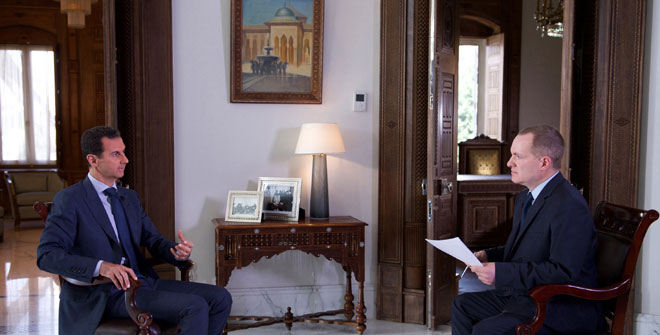
(AhlulBayt News Agency) - President Bashar Assad rejected U.S. accusations that Syrian or Russian planes struck an aid convoy in Aleppo or that his troops were preventing food from entering the city's rebel-held eastern neighborhoods, blaming the U.S. for the collapse of a cease-fire many had hoped would bring relief to the war-ravaged country.
Assad also said deadly airstrikes by the U.S.-led coalition on Syrian troops last week were intentional, dismissing American officials' statements that they were an accident. Assad said the U.S. lacked "the will" to join forces with Russia in fighting extremists.
In Washington, the State Department countered that Assad's assertions on the attack were "ridiculous."
Assad said, a sign of how his rule, which once seemed threatened by the rebellion, has been solidified by his forces' military advances and by the air campaign of his ally Russia, which turned the tables on the battlefield last year.
He said his enemies alone were to blame for nearly six years of devastation across Syria, and while acknowledging some mistakes, he repeatedly denied any excesses by his troops. He said the war was only likely to "drag on" because of continued external support for his opponents
"When you have many external factors that you don't control, it's going to drag on and no one in this world can tell you when" the war will end, he said, insisting Syrians who fled the country could return within a few months if the U.S., Saudi Arabia, Turkey and Qatar stopped backing insurgents.
The Syrian capital, seat of Assad's power, has stayed relatively untouched throughout the conflict, spared the devastation inflicted on other, opposition-held areas of the country. In recent months, Assad's forces have taken rebel strongholds in suburbs of the capital, bolstering security and reducing the threat of mortar shells.
The attack on the aid convoy outside Aleppo took place Monday night, hitting a warehouse as aid workers unloaded cargo and triggering huge explosions. Footage filmed by rescuers showed torn flesh being picked from the wreckage. Witnesses described a sustained, two-hour barrage that included barrel bombs — crude, unguided explosives that the Syrian government drops from helicopters.
Assad dismissed the claims, saying whatever American officials say "has no credibility" and is "just lies."
Like Syria, Russia has denied carrying out the convoy bombing.
Syria and the United States have been at loggerheads since the Sept. 17 airstrikes by the U.S.-led coalition that hit Syrian troops in the eastern province of Deir el-Zour. U.S. officials said the attack — its first direct hit on Syrian forces since the civil war began — was accidental and that the warplanes thought they were targeting ISIS group positions. Russia said the strikes killed more than 60 Syrian troops, and afterward, IS militants briefly overran government positions in the area until they were beaten back.
Assad said he did not believe the American account and said that attack targeted a "huge" area constituting many hills.
"It wasn't an accident by one airplane... It was four airplanes that kept attacking the position of the Syrian troops for nearly one hour, or a little bit more than one hour," Assad said in the interview. "You don't commit a mistake for more than one hour."
"How could they (ISIS) know that the Americans are going to attack that position in order to gather their militants to attack right away and to capture it one hour after the strike?" Assad asked. "So it was definitely intentional, not unintentional as they claimed."
Assad said the United States lacked the will to work with Russia against extremists in Syria. "I don't believe the United States will be ready to join Russia in fighting terrorists in Syria," he said.
He denied claims of malnutrition and a chronic lack of medical supplies.
"If there's really a siege around the city of Aleppo, people would have been dead by now," Assad said, asking how rebels were able to smuggle in arms but apparently not food or medicine.
Assad scoffed at the idea that Syria's "White Helmets" — civil defense volunteers in opposition held areas seen by many as symbols of bravery and defiance — might be considered for a Nobel Peace Prize after a nomination earlier this year."What did they achieve in Syria?" he said. "I would only give a prize to whoever works for the peace in Syria."
The group shared this year's Right Livelihood Award, sometimes known as the "Alternative Nobel," with activists from Egypt and Russia and a Turkish newspaper, the prize foundation announced Thursday.
Asked about his methods, including the use of indiscriminate weapons, Assad said "when you have terrorists, you don't throw at them balloons, or you don't use rubber sticks for example. You have to use armaments."
/298



