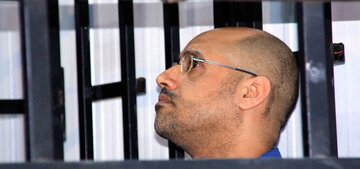
AhlulBayt News Agency (ABNA): The family of Saif al-Islam Gadhafi, son of former Libyan leader Muammar Gadhafi, announced that his body will be buried in Bani Walid, a town south of Tripoli that remains loyal to the Gadhafi family. The funeral is scheduled to take place on Friday.
According to two of Saif al-Islam’s brothers, the timing and location of the burial were decided in agreement among family members. His half-brother, Mohamed Gadhafi, wrote on Facebook that the choice was made “out of respect” for a town that maintained its loyalty even after the overthrow and death of Muammar Gadhafi in 2011.
Saif al-Islam Gadhafi was shot and killed last Tuesday in the town of Zintan in northwestern Libya. Simultaneously with the burial announcement, the Libyan prosecutor’s office declared the launch of an official investigation into the incident. Prosecutors reported that forensic experts have been dispatched to Zintan, while efforts continue to identify suspects and interview witnesses. The prosecutor’s statement confirmed that the victim died from gunshot wounds.
Marcel Ceccaldi, Saif al-Islam’s French lawyer, stated that he was killed by “a four-person unknown group” that raided his residence. According to his advisors, the attackers disabled surveillance cameras before executing him.
Following the fall of his father’s regime in 2011, Saif al-Islam faced charges of crimes against humanity by the International Criminal Court. He was briefly detained, sentenced to death in Tripoli, and later granted amnesty.
Amnesty International, responding to the killing, stated that the death of an individual accused of serious crimes deprives victims of their right to truth, justice, and reparations, while simultaneously highlighting the pervasive culture of impunity in Libya.
Saif al-Islam, 53, held a PhD from the London School of Economics and was once considered by some as his father’s natural successor. Although he held no official position, he projected a reformist image—a perception that collapsed during the 2011 protests when he threatened “rivers of blood.” In 2021, he announced his candidacy for the presidential elections, which were indefinitely postponed.
Mohamed al-Menfi, President of Libya’s Presidential Council, urged political factions and media outlets to exercise restraint and wait for the results of the official investigation, warning that escalating tensions could undermine national reconciliation and the prospects for free elections.
Public speculation in Libya surrounds the perpetrators of the assassination, ranging from local armed groups in Zintan to potential foreign involvement. Some analysts argue that Saif al-Islam’s removal benefits the country’s main power players, as he was the last prominent figure linked to the pre-2011 era.
As investigations continue, the identity of the attackers and their true motives remain shrouded in uncertainty, making the murder of Gadhafi’s son one of Libya’s most sensitive political and security issues today.
**************
End/ 345E