
(AhlulBayt News Agency) - The issue of Ghadir is a
clear historical and Islamic issue. The doubts and questions - about the
meaning of this sentence - that have come to the minds of some
intellectual and philosophical newcomers of today are the same doubts
and questions that have been raised since a thousand years ago. And
these questions have been answered by great Ulema (religious scholars).
Therefore, there is not any room for raising doubts about the essence of
this issue, this event and what the Holy Prophet (s.w.a.) said.
On
that day, the Holy Prophet (s.w.a.) asked the people, "Am I not closer
to you than your own selves?" This sentence was a reference to a Quranic
ayah which said, "The Prophet is closer to the believers than their own
selves" [The Holy Quran, 33: 6]. Then, the Holy Prophet (s.w.a.) said,
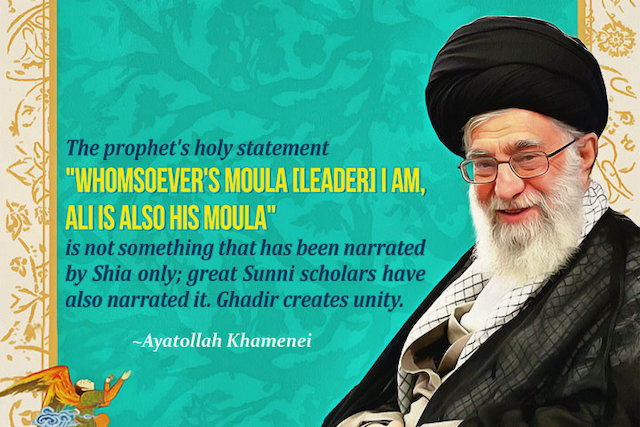
"Whomsoever's Moula I am, Ali is also his Moula". So, there is not any
room for doubt about the essence of this issue.
What should be
said about the content of this historical, holy and meaningful sentence -
apart from the appointment of the Commander of the Faithful (a.s.) as
the caliph and Imam after the Holy Prophet (s.w.a.) which is the common
meaning of this sentence - is that there is another important issue
which should not be ignored. This issue is the attention of Islam to the
issue of government and politics and the significance of this issue
from the viewpoint of Islam.
The answer to those people who have
tried to throw Islam out of the arena of social and political issues, to
confine it to personal and individual affairs and to adopt a secular
outlook towards Islam - the hands of the enemies and their propaganda
efforts have been promoting this outlook among Muslims for many years -
is the issue of Ghadir. At the command of Allah the Exalted, the Holy
Prophet (God's greetings be upon him and his household) addressed an
important and fundamental issue in that sensitive condition and during
the last months of his life. This important issue was attending to the
issue of government after the Holy Prophet's (s.w.a.) time.
Here,
the appointment of the Commander of the Faithful (a.s.) was not
confined to spiritual aspects. Rather, it can be said that spiritual
aspects are not things that someone can be appointed and elected for.
Those issues for which someone can be appointed are government, politics
and the management of the country and the Islamic society. The Holy
Prophet (s.w.a.) recommended this to the people. This is an important
point on the issue of Ghadir and it is a rejoinder to all those people
who think and promote the idea that Islam should be kept away from
political issues, issues related to the government and the like.
Therefore,
these two truths - that is to say, the truth about the appointment of
the Commander of the Faithful (a.s.) as the Imam after the Holy Prophet
(s.w.a.) and the truth about attending to the issue of government,
politics, imamate and managing the Islamic Ummah after the Holy Prophet
(s.w.a.) - and these two very important and sensitive issues exist in
the event of Ghadir. They are among teachings that have been guaranteed
by Ghadir and they are a great lesson for all Muslims, whether for their
present time or for their future.
Today, what we should pay
attention to is that the issue of Ghadir is an ideological issue. Shia
and the followers of the school of the Holy Prophet's (s.w.a.) household
and the school of imamate are committed to the issue of Ghadir. Without
a doubt, this is the base of Shia philosophy and there is no room for
any discussion on this issue. Those who doubt this and those who have a
question in this regard can take part in scholarly and expert meetings
and discuss it.
Shia's logic is strong. Its reasoning is decisive
and impeccable. However, this should not influence the public lives of
Muslims, their cooperation with and brotherhood towards one another. The
issue of differences between Muslim denominations - whether Shia and
Sunni denominations or the different denominations that exist inside
these two major denominations - has been one of the targets of the greed
of the enemies of Islam, not just the enemies of Shia Islam.
For
many years, there has been an effort to create discord between Muslims.
This is because the existence of discord between Muslims will make them
spend their efforts, energy and motivation on domestic fights. This
makes them ignore foreign affairs and their great enemies. This has been
the major policy of colonialism for many years and after the victory of
the Islamic Revolution and the formation of the Islamic Republic.
Because they witnessed the development of the Islamic Republic's
thoughts in the world of Islam, they placed more emphasis on and showed
more persistence in creating discord. They invested in doing this in
order to separate the world of Islam from the Islamic Republic.
Ayatollah Khamenei's Speech on the Occasion Eid al-Ghadir, Oct 13, 2014
/129
5 July 2023 - 04:03
News ID: 1377226
The issue of differences between Muslim denominations - whether Shia and Sunni denominations or the different denominations that exist inside these two major denominations - has been one of the targets of the greed of the enemies of Islam, not just the enemies of Shia Islam.