infographic
-

infographic:
Standing with oppressed: A duty grounded in justice
AhlulBayt News Agency: The Quran does not consider support for oppressed human beings to be merely a moral recommendation; rather, in the face of oppression, it calls the believing human being to aid the oppressed and defend the truth, and even in conditions of conflict, it deems the observance of justice essential.
-

Infographic: Respecting Personal Privacy in Quran
AhlulBayt News Agency: In the era of social networks, the boundary between private and public life has become increasingly blurred; the Quran, for preserving psychological and social security, has clear rules even regarding entering the privacy of others.
-
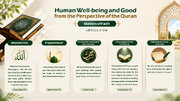
Infographic: Human Well-being and Good from Perspective of Quran
AhlulBayt News Agency: The Holy Quran does not seek human good and welfare solely in individual and social conduct, but considers the root of happiness to lie in the rectification of belief and the relationship between man and God—from monotheism and acceptance of prophethood, to fidelity to the divine covenant, obedience to God's command, worship, and piety. In this view, faith and servitude are not merely an obligation, but rather the path to true human good and welfare.
-

Infographic: Human Good and welfare of man in social life; Quran's recommendations for building valid society
AhlulBayt News Agency: The Holy Quran does not confine human good and welfare to worship and the correction of individual affairs alone, but also offers solutions for social relations and mutual rights toward others and society. Observing economic rights, respecting privacy, showing leniency toward debtors, striving (jihad), defending against enemies, and prioritizing the remembrance of God over trade are teachings that show that, from the Quran's perspective, human good also depends on responsible behavior and respecting the rights of others in society.
-
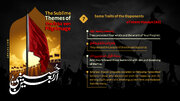
Infographic: Some Traits of Opponents of Imam Hussain / 7
AhlulBayt News Agency: In continuing its elucidation of the factors that give rise to the front of falsehood, the Ziyarat al-Arbaeen points to some of the characteristics of the opponents of Imam Hussain (a.s.). This Ziyarat identifies following the currents of hypocrisy, fomenting discord, and aligning with the sinful as among the most important factors of deviation.
-
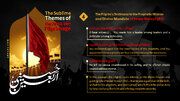
Infographic: Pilgrim's Testimony to Prophetic Mission and Divine Mandate of Imam Hussain (a.s.) / 4
AhlulBayt News Agency: In a section of the Ziyarat al-Arbaeen, the divine mission and purpose of Imam Hussain (a.s.) are elucidated, and the pilgrim is called to bear witness to his unparalleled role in guiding humanity. In this passage, the Imam is introduced as the inheritor of the prophets, the Proof of God (Hujjat Allah), the leader of guidance, and the guardian of religion—who, through a clear invitation and complete sincerity, established the divine proof upon all and fulfilled his divine mission to perfection.
-
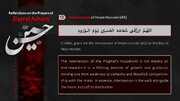
Reflection on the Prayers of Ziyarat Ashura
Infographic: Intercession of Imam Hussain (a.s.)
AhlulBayt News Agency: In the perspective of Ziyarat Ashura, intercession (Shafa'ah) is not merely salvation from punishment, but rather "divine sustenance" (Rizq) and a continuous flow of purification, guidance, and elevation of the human being to higher stations of monotheism—a sustenance that originates from Imam Hussain (a.s.) and extends all the way to divine proximity and knowledge of God.
-
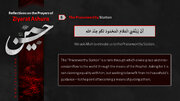
Reflection on the Prayers of Ziyarat Ashura
Infographic: The Praiseworthy Station
AhlulBayt News Agency: In Ziyarat Ashura, the request to attain the "Maqam Mahmud" (the Praiseworthy Station) does not mean seeking the station of the Prophet (PBUH) himself; rather, it signifies connecting to the source of intercession and divine mercy in the light of the Wilayah of the Ahlulbayt (a.s.), so that one may benefit from intercession and, under the shadow of Wilayah, become a means of guiding others and drawing hearts toward the Imam (a.s.).
-

Strengthening Spirit of Servitude with Daily Recommended Prayers – Sunday
AhlulBayt News Agency: Alongside obligatory prayers, Islamic teachings recommend special supererogatory (mustahabb) prayers for each day of the week. By performing these, one can strengthen their spiritual connection with God and benefit from their blessings each day. These prayers serve as an opportunity to reinforce the spirit of servitude in a believer's life.
-

Infographic:
Sha‘baniyah Sermon: A Guide to Spiritual Conduct in Month of Ramadan — Parts 5
AhlulBayt News Agency: The Sha‘baniyah Sermon is one of the most beautiful and valuable ethical and doctrinal manifestos regarding the greatness and virtues of the blessed month of Ramadan. The Prophet of Islam (PBUH) delivered this sermon to his companions on the last Friday of Sha‘ban. Its main themes include honoring the month of Ramadan, caring for the needy, guarding one’s eyes, ears, and tongue, reciting the Qur’an, sending blessings upon the Prophet, remembering the Day of Judgment, and more. This sermon was narrated by Imam al‑Reza (a.s.) from Imam Ali (a.s.).
-
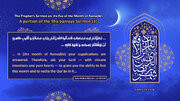
Infographic:
Sha‘baniyah Sermon: A Guide to Spiritual Conduct in Month of Ramadan — Parts 3
AhlulBayt News Agency: The Sha‘baniyah Sermon is one of the most beautiful and valuable ethical and doctrinal manifestos regarding the greatness and virtues of the blessed month of Ramadan. The Prophet of Islam (PBUH) delivered this sermon to his companions on the last Friday of Sha‘ban. Its main themes include honoring the month of Ramadan, caring for the needy, guarding one’s eyes, ears, and tongue, reciting the Qur’an, sending blessings upon the Prophet, remembering the Day of Judgment, and more. This sermon was narrated by Imam al‑Reza (a.s.) from Imam Ali (a.s.).
-
-