
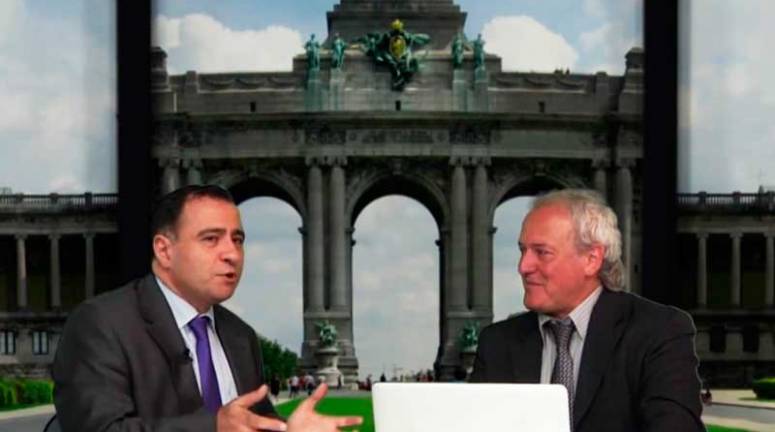
Created in 1969, the Organisation of Islamic Cooperation (OIC) wants to be “the collective voice of the Muslim world”, working to “safeguard and protect the interests of the Muslim world in the spirit of promoting international peace and harmony”. With 57 member states, it represents practically all Muslim countries, and countries with Muslim minorities, with the notable exception of India. Although India has about 12% (roughly 183 million) of the world’s Muslim population, it has been blocked by Pakistan from joining the OIC. Another country, this time with a Muslim majority, absent from the organisation is Syria, which was expelled. The new OIC Permanent Observer to the EU is Ambassador Arif Mammadov from Azerbaijan. New Europe asked Arif Mammadov whether the organisation would still be called “Islamic” today, and not simply “Muslim” given the negative connotations the term “Islamic” has taken since its foundation, being associated today rather with fundamentalism and militantism.
Arif Mammadov: No, I think we would still call ourselves “Islamic” even today, given that Islam is the main point of reference here, and that Islam is by excellence a religion of peace. We are not afraid of stereotypes about Islam. By keeping “Islamic” in the name, we are delivering a message of peace. OIC is also the second biggest organisation after the United Nations. Its main raison d’être in the beginning was the issue of Palestine.
New Europe: You call it a religion of peace, but we see Islam involved in many conflicts today.
Arif Mammadov: You know, injustices can take many forms, and people are pushed to resist. Their resistance can sometimes take on a violent form. It is only human to react.
New Europe: OIC reunites countries practising all kinds of Islam, Sunni as well as Shia… Are there no internal tensions?
Arif Mammadov: Yes, of course, Iran is a member, but also Azerbaijan, my country, where half of the population are Shia. The division practiced between the various kinds of Islam are artificial and exaggerated. The seat of the OIS is in Jedda, close to Mecca, and this is giving it a supplementary authority. The whole of Umma is under the shelter of OIS, Central Asia, Iran, the Caucasus and Africa, and all the countries of the Arab League.
New Europe: How do you see now the prediction about the clash of civilisations in this century, a conflict between the West and Islam?
Arif Mammadov: I don’t believe in Huntington’s theory about the clash of civilisations. Those who like this kind of theory are the same who share conspiracy theories. It is true that in the Middle East and in Africa everything seems now to be burning and heading to a disaster. The security and the future of the world depend on how Islam, Judaism and Christianity can live together. These three monotheistic religions have so much in common…
New Europe: The “People of the Book”.
Arif Mammadov: Exactly, People of the Book. Jesus is the most revered prophet in the Koran, after Mohammed. In the Koran, Jesus has been given the Holy Spirit. The only other one was Adam, the first human being, into whom God breathed Holy Spirit.
New Europe: And according to the Koran, Jesus will come at the end of the World as a Judge…
Arif Mammadov: Exactly. Christians should know how much Islam reveres Jesus. Muslims’attitude towards Jesus is closer to that of the early Christians. Christians, Muslims and Jews have always live in harmony in the Holy Land. But in order to avoid the clash of civilisations, we have to solve the Palestinian issue.
New Europe: Let’s hope it happens before the second coming of Christ.
Arif Mammadov: I am convinced it will happen.
/129



